
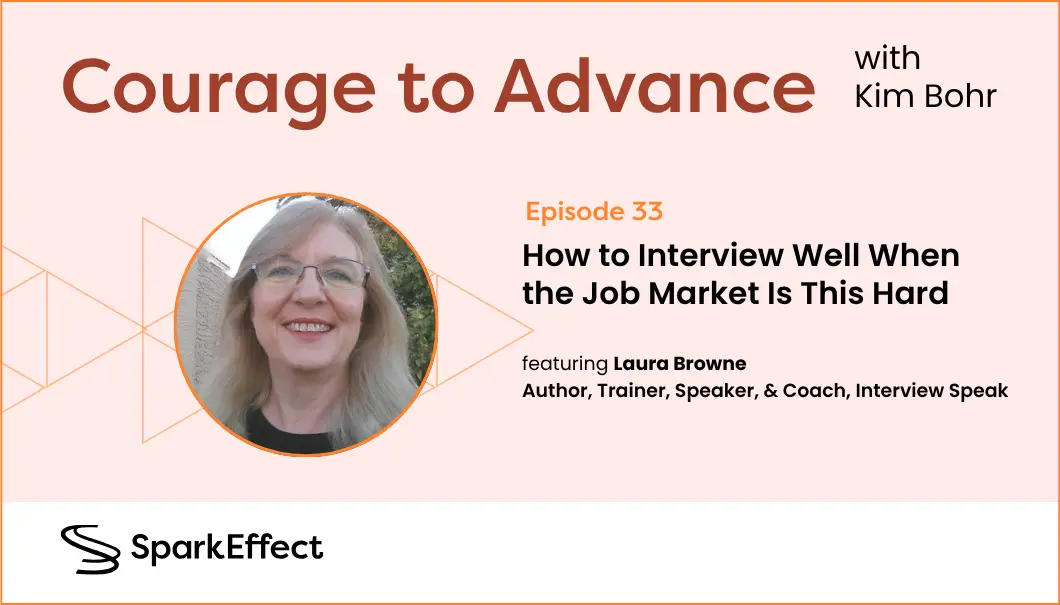





Episode 33 Featuring Laura Browne, Author, Interview Speak
The job market is brutal right now, and the advice most candidates carry into an interview is quietly working against them. Roles that used to draw a hundred applications now draw a thousand. People who once lined up several interviews wait months for one. And the standard playbook, memorize the perfect answer and perform it, is the fastest way to lose the room.
Most people treat an interview as a test to pass and the interviewer as a judge to impress. Laura Browne says that framing is backward. After years in senior HR leadership, she watched candidate after candidate deliver rehearsed answers that experienced interviewers have heard a hundred times. She also names the part almost no one talks about, that the interviewer is often more scared than the candidate, worried they will look bad if they advance the wrong person.
Laura is an author, trainer, speaker, and business coach who spent years in global tech HR training leaders and executives to interview and hire well. She now teaches candidates the other side of the table through her company, Interview Speak, and her book Interview Speak: What Your Interviewer Really Wants To Know. Her core move is to stop treating the interview as a fight and start treating it as a partnership, where both people actually want the same outcome.
In this conversation with host Kim Bohr, Laura breaks down the three things every interviewer is really screening for, how to open strong in the first five minutes, why hiding salary erodes trust on both sides, and how to negotiate compensation without overplaying your hand. For HR and talent leaders, it doubles as a mirror, because the way an organization interviews is the first signal a candidate gets about whether the place can be trusted.
Watch
Listen
🎧 Hear Laura Browne’s Full Conversation
Want the full episode? Listen to Laura Browne on Courage to Advance, where she and host Kim Bohr break down what interviewers really want, how to open strong in the first five minutes, and how to talk salary without losing the room.
What You’ll Discover
- Why the interviewer is often more nervous than the candidate, and how that changes the way you should show up
- The three things every interviewer is screening for, and the one candidates almost always skip
- How to answer “tell me about yourself” so the first five minutes work in your favor instead of against you
- Why saying you have no questions is one of the worst moves you can make, and what to ask instead
- The one salary phrase that invites a real negotiation, and why staying quiet right after it matters
- How compensation splits into buckets beyond base pay, from signing bonuses to salary bands you can move up
- When it actually makes sense not to negotiate in a market this tight
- What hiding a salary range signals to candidates, and why Laura says the practice has to stop
Episode Highlights
[00:00] The uncomfortable truth about interviewing. Kim opens on the idea that the person across the table is often more scared than the candidate, and that how a leader handles that moment signals whether the place can be trusted.
[02:29] A market where a hundred applications became a thousand. Kim and Laura lay out how much harder the search has gotten, with senior roles flooded and people out of work for a year or more.
[06:41] The problem with the perfect scripted answer. Laura explains why rehearsed answers backfire with experienced interviewers, and how her co-author Barbara started pushing clients for their real answer instead.
[08:21] Why an interview is a partnership, not a fight. Laura reframes the interview as two people who want the same thing, and shows how that shift changes the answers a candidate gives.
[11:45] The three things every interviewer wants to know. Laura breaks down can you do the job, do you want this job, and will you fit the team, and why candidates almost always miss the second one.
[13:05] The interviewer is scared too. Laura describes the fear on the other side of the table, and how helping the interviewer feel confident in you is what builds real trust.
[15:01] How to actually answer “tell me about yourself.” Laura walks through her method for the first five minutes, from a quick connection to a few role-specific accomplishments, and why running five minutes long loses the room.
[18:09] The question you have to be ready for at the end. Laura explains why the closing “do you have any questions” is a trust test, and why leading with the vacation policy can cost you the job.
[20:42] Laura’s favorite topic, money. The conversation turns to salary, where Laura shares how to invite a negotiation with “is there any flexibility,” why you then stop talking, and how compensation lives in more buckets than base pay.
[29:25] Stop hiding the salary. Laura makes the case for posting ranges, killing the “what salary are you looking for” question, and using bands transparently to build trust from the first touch.
[31:39] What courage to advance means to Laura. She shares the question on her refrigerator and her eat the frog first rule for doing the hard thing before anything else.
Key Takeaways for HR Leaders
- An interview is a two way trust event, not a one way screen. The way your team interviews is the first thing a candidate learns about your culture. Train interviewers to treat the conversation as a partnership, because a candidate who feels judged forms a view of your organization long before an offer exists.
- Rehearsed answers hide the person you are actually hiring. Experienced interviewers have heard the canned answers, and taking them at face value is how the wrong person gets hired. Coach your team to push one level deeper with “tell me more” or “give me an example” instead of accepting the surface response.
- Candidates are graded on three things, and most only answer one. Beyond whether someone can do the job, interviewers need to know whether the person wants this specific job and will fit the team. Build your questions to surface motivation and fit, not just capability, and tell candidates what you are really asking.
- Hiding the salary costs you trust and strong candidates. Laura’s clearest instruction to organizations is to post the range and stop asking what salary someone is looking for. Springing a low number late in the process is what makes good candidates walk and speak poorly about the company afterward.
- Compensation is more than base pay, and saying so builds goodwill. When the salary bucket is capped, signing bonuses, stay bonuses, training, and movement between salary bands are still on the table. Naming those options turns a tense negotiation into a collaborative one.
- In a market this hard, how you treat candidates is a reputation strategy. With senior roles drawing a thousand applications and people out of work for a year, every interaction is amplified. A transparent, respectful process is not just fair, it protects your employer brand when candidates are most vulnerable.
About Our Guest
Laura Browne is an author, trainer, speaker, and business coach who helps people be more successful. She spent years in senior HR leadership at global tech companies, where she trained managers, leaders, and executives on how to interview and hire well. She now works the other side of the table, teaching candidates how to have more successful and less stressful interviews through her company, Interview Speak, and her online course Translating Interview Speak.
Her newest book, Interview Speak: What Your Interviewer Really Wants To Know, decodes the questions and concerns interviewers rarely say out loud. She is also the author of other business and fiction titles, including Help! My Company Swiped Left!, Increase Your Income: 7 Rules for Women Who Want To Make More Money at Work, and A Salary Cinderella Story.
Laura has written for Forbes and has been quoted as a business expert in Cosmopolitan, Family Circle, and USA Weekend
Connect with Laura Browne
- Website, https://interviewspeak.com/
- LinkedIn, https://www.linkedin.com/in/laurabrowne/
- Book, Interview Speak: What Your Interviewer Really Wants To Know https://share.google/UMte2XBWIh8j6ca8f
- Online course, Translating Interview Speak, at https://interviewspeak.com/
- Email, laura@interviewspeak.com
Notable Quotes
Laura Browne “Companies need to stop hiding salary, because I think that is absolute nonsense.”
Laura Browne: “It’s obvious you want a paycheck. It’s obviously you want a job. But what interviewers really need to find out and need to ask more questions about is, do you want this job?”
Kim Bohr: “The person on the other side of the table is often more scared than the candidate. And how a leader handles that moment quietly tells everyone whether this is a place they can trust.”
Kim Bohr: “You’re kind of this trust signal that’s certainly going to outlast the hire or the moment of the interview.”
Related Resources
SparkEffect Trust Study 2026 — https://info.sparkeffect.com/trust
SparkEffect Executive Coaching — https://sparkeffect.com/what-we-do/executive-coaching/
SparkEffect Leadership Development Programs — https://sparkeffect.com/what-we-do/leadership-development-programs/
Science of Trust eBook: https://sparkeffect.com/the-science-of-trust-ebook/
SparkEffect CEO and Board Advisory: https://sparkeffect.com/what-we-do/ceo-board-advisory/
- Connect with the Host: Kim Bohr – https://www.linkedin.com/in/kimbohr/
About Courage to Advance
Courage to Advance explores how visionary leaders are building the organizations they wish existed, companies that prove business doesn’t have to be dehumanizing. Hosted by Kim Bohr, President and COO of SparkEffect, each episode features executives who refuse to accept that traditional corporate practices are inevitable, sharing the experiments, resistance, and breakthrough results of choosing human flourishing alongside business success.
Subscribe anywhere you listen to podcasts. You can find links to all platforms HERE!
Visit: https://sparkeffect.com/sparkeffect-podcast-courage-to-advance/ for free resources and tools.
Receive New Podcast Episodes in Your Inbox