

There’s a number that keeps surfacing in every boardroom and strategy session. Everyone points to it: Harvard, McKinsey, BCG. But the real question isn’t who cites it. It’s what leaders actually do about it.
Seventy percent of change initiatives fail.
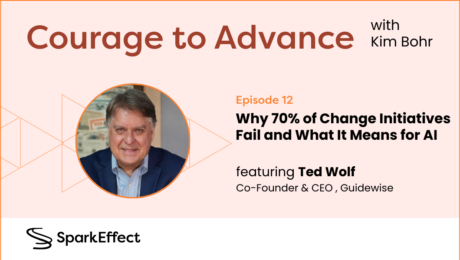
Ted knows what it takes. Over 18 years, he built a technology staffing company from a $1,000 startup into a 650-employee organization with 13 offices, eventually leading it to an acquisition by a Fortune 1000 company. Along the way, he oversaw hundreds of technology rollouts and began noticing the same patterns emerging again and again. He later spent years overseeing more than 300 ERP and technology implementations, further reinforcing those insights.
- The technology worked.
- The business case was there.
- The people didn’t change.
That experience became the foundation for Guidewise and its Changeworks platform, a system built to measure what most organizations have never thought to measure: what employees actually believe, feel, and make meaning of during a change initiative. Not project milestones. The inner game.
🎧 LISTEN: Hear Ted’s Full Story
Want to hear the complete conversation? Listen to Ted Wolf’s episode on Courage to Advance, where he walks through real examples of pilot purgatory in action, how the Changeworks platform measures employee beliefs and emotions during an AI rollout, and his advice for HR leaders who want a seat at the table before the plan is already built. [Listen to Episode →]
AI Is Not an IT Project. Stop Treating It Like One.
Ted identifies a critical, costly error right away: assigning the AI rollout solely to IT and treating it as just another tech project is unacceptable.
IT teams are indispensable. Their expertise ensures system stability. But they are not equipped to address the real driver of AI success: how people adapt to changes in the way they work.
Why AI Is Different from Other Tech Rollouts
Unlike a standard software implementation, AI touches your organization in ways most leaders haven’t fully reckoned with:
- It doesn’t just change one team’s workflow. It connects to every department’s data.
- It puts information in everyone’s hands and breaks down the silos you might not even see.
- It changes reporting structures, daily tasks, and in many cases, people’s sense of what their role even is.
- If those changes come from the top without real preparation or openness, trust breaks down quickly.
“When trust begins to erode, that means leadership did not communicate very well why the change is necessary and what the impact is going to be on workflow and day-to-day tasks. And once your trust starts to erode, it’s a long, difficult road to come back.”
- Ted Wolf
What the Trust Study Tells Us
SparkEffect’s own Trust Study directly reinforces this. AI-driven system changes are the number one disruptor organizations face right now. And yet, they are not the biggest trust-breaker. Leadership behavior during the rollout is.
The gap between what leaders announce and what employees actually experience is where trust breaks down. By the time most organizations notice it, the damage is already done.
What Is Pilot Purgatory and Are You Already In It?
Ted coined the term “pilot purgatory,” and once you hear it, you’ll recognize it immediately.
The Pattern That Keeps Playing Out
Pilot purgatory is what happens when an organization runs multiple AI pilots across departments, none of them tied to a shared business objective:
- Sales runs its own pilot.
- Marketing runs its own.
- Operations has something going on in the background.
- Six months pass, and there’s still no clear result.
The core problem isn’t the pilots. It’s the absence of a clear answer to what Ted calls the fundamental questions of change: the who, what, where, when, why, and how. Without those answers communicated consistently from senior leadership to the frontline, employees have no way to process what’s happening. So they don’t. They work around it, wait it out, or disengage entirely.
Three Things That Break the Cycle
Getting out of pilot purgatory starts here:
- A clear business objective
- Shared metrics that tell you whether you’re succeeding
- An actual timeline with milestones, not a vague “we’ll revisit this in Q3.”
People can orient themselves around milestones. They can’t orient themselves around ambiguity.
The Inner Game: The Variable Nobody Is Measuring
Here is the part of the AI conversation that few are having.
Every employee navigating a major change initiative is running a quiet internal calculation. It shapes engagement levels, productivity, and adoption rates more directly than any training program or communication strategy. Ted calls it the inner game.
What the Inner Game Is Made Of
The inner game sits at the intersection of three things:
- Beliefs: What do employees actually believe about what leadership is telling them?
- Emotions: What are they feeling day-to-day as the rollout unfolds?
- Meaning: What does this change say about their future, their career, their value here?
“They’re telling me why it’s important, but do I believe them? Do I trust what they’re telling me? Do they have my best interests? Are they telling me the truth? Or are they just telling me this so they can replace me next year?”
- Ted Wolf
How Guidewise AI Surfaces What’s Hidden
HR’s Seat at the Table Is Not Optional
How It Usually Goes and Why It Fails
- Every department’s data
- Every employee’s sense of career security
- Every manager’s ability to lead their team through uncertainty
Where HR Needs to Be Instead
- The business objective is being defined.
- Decisions are being made about which departments are involved.
- Governance structures are being built around AI agent accountability.
- Policies around who uses which tools are being set
The Dual Workforce Is Coming. The Culture Question Is Now.
One of the most important reframes Ted offers is about where all of this is ultimately headed.
What the Future of Work Actually Looks Like
The future of work, in Ted’s view, is a dual workforce: human employees and AI agents working in tandem, with people managing agents the way they currently manage other people.
“You’re not going to lose your job. It’s going to be different. You’re going to manage an agentic workforce. Managing 10 agents is no different than managing 10 employees. You have to check on their work, onboard them properly, have policies they follow.”
- Ted Wolf
Why This Reframe Changes Everything
- In the months and years before
- In the small decisions about how leaders communicate
- In how trust is earned and maintained before it’s ever tested
- In how employees are prepared for change before it arrives at their desk
What Getting It Right Actually Looks Like
Ted defines successful AI implementation as three critical elements working in unison. While most organizations get the first two right, very few accomplish the crucial third element.
The Three-Part Framework
- A clear business objective that the AI is meant to serve
- Technology selected specifically to serve that objective
- A people adoption plan designed to get employees to actually use it
What a Real Change Adoption Plan Requires
A change adoption plan is more than communication or training. It is a structured way to track employees’ beliefs before, during, and after the rollout. That means:
- Collect people metrics, not just project metrics- Identify employee beliefs about the change
- Notice emotions that surface
- Find out what meaning employees areassigning to the change
Without this data, leaders make change decisions blindly.
Top-Down and Bottom-Up, Together
The macro directive from senior leadership matters. But it only reaches its full effect when matched by genuine engagement at the frontline when managers have the tools and the trust to have honest conversations with their teams, and when employees get a clear answer to the question that matters most: What does this mean for me?
Download the Complete Research
Get the full SparkEffect Trust Study with detailed breakdowns by industry, organization size, and leadership level. [Research link]
Hear Ted’s Full Story
Listen to the complete Courage to Advance conversation, including how Ted navigated real pilot purgatory situations inside organizations, the specific metrics Changeworks uses to measure employee beliefs and emotions during an AI rollout, and his advice for HR leaders who want to get in the room before the plan is already built. [Podcast link]
Work with SparkEffect
If your organization is facing the kind of crisis Tammy inherited, or you want to build trust infrastructure before crisis hits, we can help. Schedule a conversation to explore how: [Contact link]
About SparkEffect
SparkEffect helps organizations build trust that bends without breaking. Our Trust Performance Index and consulting services give leadership teams the tools to diagnose trust gaps and build the infrastructure required for lasting transformation.
The Courage to Advance podcast features leaders building the organizations they wish existed, proving that business doesn’t have to be dehumanizing.