
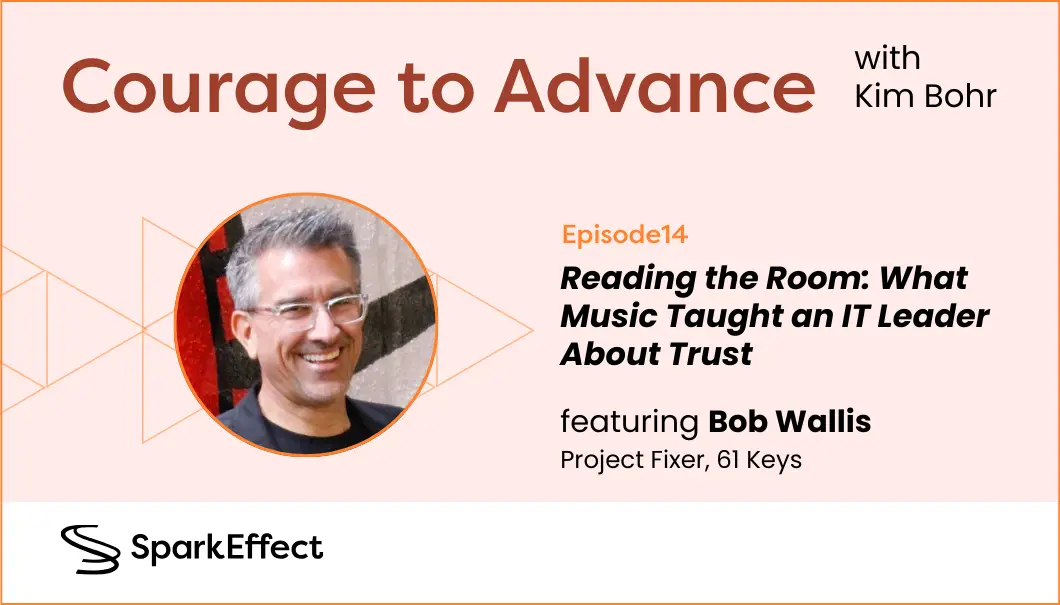





Episode 14: Featuring Bob Wallis, Project Fixer for Hire, 61 Keys
What if the most important skill for leading a technology transformation has nothing to do with technology?
Bob Wallis has spent his career proving that the difference between a system rollout that succeeds and one that quietly destroys organizational trust comes down to one thing: how well you read the room. A fractional CIO who brings equal parts head and heart to complex implementations, Bob caught Kim Bohr’s attention for exactly that reason. Bob draws on a career that spans music education, Fortune 500 leadership development, and multi-million dollar system rollouts to make the case that trust isn’t a soft skill. It’s the foundation everything else is built on, and SparkEffect’s own research backs that up. In our Trust Study, only 36% of organizations that faced disruption emerged with stronger trust. The other 64% lost ground; they’re still trying to recover.
And his measure of success isn’t a smooth go-live. It’s walking out the door knowing the internal leaders he developed can carry the work forward without him.
Listen
Watch
What You’ll Discover
- Why trust not technology is the real foundation of every successful transformation
- How reading a room translates from the stage to the boardroom to the project steerco
- Why vendor relationships matter more than vendor platforms and how to evaluate them
- What the aircraft carrier curve is and why naming the dip protects your team before it happens
- How the Know-Feel-Do communication framework keeps leaders intentional during uncertainty
- Why HR belongs at the table with genuine authority not as a downstream stakeholder
- How to develop internal leaders during a project so the organization comes out stronger
- What it looks like when a consultant’s real goal is to never be needed again
Episode Highlights
[00:00] Introduction: The Trust Problem Nobody is Talking About. Kim introduces Bob Wallis, a fractional IT executive who believes most technology projects fail not because the software broke, but because trust did.
[01:14] From Music School to the Boardroom: Bob traces the through-line from running a rock music school to leading complex ERP implementations and why reading an audience on stage prepared him for the boardroom.
[03:40] What Separates Projects That Succeed From Ones That Crash One: Bob breaks down the common themes he sees across failing transformations and why the real culprits are rarely technical.
[07:08] The Aircraft Carrier Curve: Naming the dip Before It Happens: Why every system rollout has an inevitable productivity drop before liftoff and why naming it honestly protects both the team and the project.
[10:12] Truth Telling During Transformation: The Know-Feel-Do Framework: How a simple three-part communication framework keeps leaders intentional rather than reactive during the hardest moments of a project.
[12:33] Who’s Missing From Your Project Team: Why most project teams are assembled by default rather than design and how the wrong room leads to costly workarounds after go-live.
[16:14] Working Yourself Out of a Job: Bob’s unconventional measure of success: leaving with an internal leader ready to take the wheel and a consultant who is no longer needed.
[17:44] Developing Internal Leaders During a Project: Why projects are one of the best development opportunities an organization has, and how Bob uses them to build the leaders who won’t need him.
[20:06] Building the Cross-Functional Team: Why every stakeholder with a voice in the outcome needs a seat at the table, and why HR belongs there with authority from day one.
[25:33] Who Should Call Bob: The kind of organization and leader Bob does his best work with, and how to reach him.
Key Takeaways for HR Leaders
- Trust is the foundation, not a feature. Technology projects don’t fail because the software broke; they fail because trust broke. Build it before you ask people to change.
- Read the room before you read the specs. The skills that make a great performer, reading an audience, building confidence, and developing people are the same skills that make transformation work.
- Vendor relationships are make-or-break. Interview vendor team members individually for trust and fit, not just capability. The relationship is the variable most leaders underestimate.
- HR belongs at the table with authority from day one. Bringing HR in early to develop teams, build culture, and shape decisions is one of the highest-ROI moves in any major project
- Working yourself out of a job is the goal. The best measure of a consultant’s success is what the organization can do without them, not how long they stay.
About Our Guest
Bob Wallis is a fractional CIO and transformation consultant who brings equal parts head and heart to complex technology projects. A career that spans music education, Fortune 500 leadership development, and multi-million dollar ERP implementations gave Bob a rare combination: deep technical instincts and an even deeper belief that trust is the foundation on which transformation is built.
Bob’s sweet spot is upper small to mid-market organizations that are serious about getting transformation right, not just checking a box. He enters every engagement looking for the internal leader he can develop to carry the work forward. His goal is always the same: to make himself unnecessary.
Connect with Bob Wallis
- Website: 61keysllc.com
- LinkedIn: Bob Wallis
Notable Quotes
Bob Wallis:
“Choosing the vendor matters more than choosing the platform.”
“I love it when I can go in, help course correct, get someone center stage, then call me if you need me.”
Kim Bohr:
“Poor handling of technology and system rollouts is one of the biggest breakers of trust — it will absolutely destroy it.”
“When we have so many changes happening that impact people at the usage level, HR leaders should really have a stronger voice in that work than just perhaps being notified.”
Related Resources
- SparkEffect Trust Study – Research showing that 71% of organizations faced disruption in the last 24 months, but only 36% emerged stronger (https://info.sparkeffect.com/trust-study-2025-download)
About Courage to Advance
Courage to Advance explores how visionary leaders are building the organizations they wish existed, companies that prove business doesn’t have to be dehumanizing. Hosted by Kim Bohr, President and COO of SparkEffect, each episode features executives who refuse to accept that traditional corporate practices are inevitable, sharing the experiments, resistance, and breakthrough results of choosing human flourishing alongside business success.
Subscribe anywhere you listen to podcasts. You can find links to all platforms HERE!
Visit: couragetoadvancepodcast.com for free resources and tools.
Receive New Podcast Episodes in Your Inbox