

Most companies treat motivation like a character trait.
When engagement drops, the finger points at the employee.
But what if the problem isn’t who you hired?
What if it’s what you never bothered to ask?
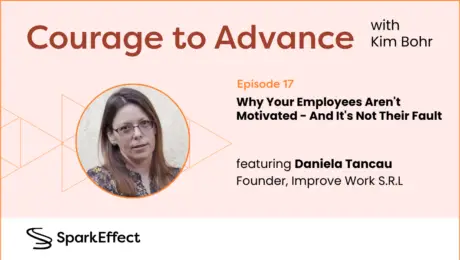
That’s the broken assumption Daniela Tancau has spent 18 years diagnosing. As the founder of Improve Work, she has conducted thousands of interviews with employees and candidates across Europe and the U.S. What she keeps finding is the same pattern: companies hire well, assign work, run surveys, and watch people check out or walk out anyway. The data exists. The tools exist. What’s missing is the willingness to ask a different question.
In a recent conversation with Kim Bohr on the Courage to Advance podcast, Daniela walked through exactly what that question looks like, why most organizations avoid it, and what changes when they don’t.
🎧 LISTEN: Hear Daniela’s Full Story
Want to hear the complete conversation? Listen to Daniela Tancau’s episode on Courage to Advance, where she and host Kim Bohr break down her structured interview methodology, the seven factors that shape employee motivation, and why the CEO should be the one having these conversations. [Listen Here!]
The Distinction Nobody Is Teaching
Personal motivation and employee motivation are not the same thing.
Personal motivation is about what someone wants for their own life: their goals, their growth, their sense of progress. Employee motivation is about what a company can offer to keep someone engaged with the company’s work and goals. These pull in different directions.
Confusing them is how organizations end up assuming that a shared mission is enough.
That if people believe in the company’s purpose, everything else follows. It doesn’t.
"Ultimately, we are thinking about ourselves, our personal goals, what we achieve, or if we are satisfied with what we are doing."
- Daniela Tancau
Seven Factors. A Different Weight for Every Person.
A compelling mission might get someone through the door. What keeps them there is whether their individual expectations are being taken seriously.
SparkEffect’s trust research found that 71% of organizations faced significant disruption in the last 24 months, but only 36% emerged with stronger trust. One of the quietest contributors to that gap is the accumulation of questions nobody asked.
Daniela’s structured interview methodology is built around seven factors that shape whether someone stays engaged or gradually disconnects:
Tasks and responsibilities
Relationships with colleagues and managers
Compensation
Career development opportunities
Work environment
Recognition
Alignment between personal professional goals and what the company offers
The point isn’t to score everyone on the same scale. It’s to understand that each person weighs these factors differently. Someone who would stay in a demanding role for the right manager might leave for a competitor over a salary gap. Someone else might do the opposite.
Anonymous surveys can measure group sentiment. They cannot tell you which factor matters most to the person sitting across from you.
“You can’t take measures to impact a specific person’s motivational level” from a questionnaire alone, she said.
Why the CEO Should Be the One Asking
This is the part that tends to stop people.
Daniela’s recommendation is that the CEO conduct these structured motivation interviews. Not a delegate. Not HR. The CEO.
Her reasoning is direct. The act of a CEO asking carries a signal that nothing else can replicate.
"I think that it's satisfying and it's a pleasure for every employee to see that their CEO is giving their time and attention to find out what they want"
- Daniela Tancau
"This in itself is a very good thing that will impact their motivation because they see that their CEO gives time to them and is interested in what they want."
- Daniela Tancau
She framed it plainly: you have to show care before you ask employees to care about your company and your goals. It is a two-way street.
Organizations that lead with demands and follow up with surveys are asking employees to extend trust that was never offered first. The structured interview, done well, reverses that order.
What Happens When You Can't Deliver Everything
Kim pushed on a real tension in this conversation. She asked Daniela directly: what do you tell leaders when interviews surface expectations the company simply cannot meet? It is one of the most practical questions a leader can face, and Daniela’s answer is grounded. Employees are not expecting perfection. What shifts engagement is visible effort.
"If they see that the company struggles or makes efforts to meet even just a few of them, their engagement improves because they see that the company does care about them"
- Daniela Tancau
She compared it to any relationship: when someone consistently signals that what you want doesn’t matter to them, you stop trying. When they show genuine interest, even with imperfect follow-through, you stay in it. Meeting every expectation is not the goal. Showing that you took them seriously is.
The Hiring Decision Nobody Wants to Admit
One of the harder parts of Daniela’s framework is what it asks of leaders before someone is even hired.
She described a situation most leaders recognize but rarely say out loud. You meet a candidate who interviews well, has the right experience, and brings real energy. You also sense that what they need professionally isn’t quite what you can offer. And you hire them anyway because the role needs to be filled.
“You know it, but you follow your goal,” Daniela said. “I have a good person. No, for a while. But after that the person will go and meet his or her needs.“
Kim named the full cost plainly: “Rehiring, retraining, disruption to the team, and the compounding effect of watching colleagues cycle through. It’s a short-term decision with a long bill.” Most leaders know this is true. Most hire the person anyway.
The fix is not complicated. It requires asking earlier, listening carefully, and being willing to pass on a strong candidate when the fit is not honest. It also requires believing that a motivated, well-matched employee is worth more than a qualified one who was always going to leave.
What Changes After
Daniela’s program includes a follow-up step to measure what has shifted once motivation plans are in place. What she consistently finds is not dramatic. It is quieter than that.
People do their work more carefully. They take more ownership of results. They stay longer.
“They care more about how they do their work, what results they obtain for the company,” she said. “Seeing that this is two-way treated, the company cares about them too. They are more open and more engaged in their work.”
Kim named what that looks like from the outside. When someone feels seen and genuinely part of building something, rather than just managed toward a goal, the quality of their work changes. That observation, from someone who works with organizations navigating disruption every day, is worth sitting with.
That is not a soft outcome. It is exactly what most organizations say they want and rarely build the conditions to create.
The Question Worth Asking
Daniela’s work is not complicated in theory. Companies already have what they need. The tools exist. The access is there. What has been missing is the willingness to ask a different question and actually listen to the answer.
That gap between knowing and doing is exactly what SparkEffect’s Trust Study set out to measure. If you want to see what the data says about where trust breaks down inside organizations, and what the 36% who came out stronger actually did differently, the full research is worth your time.
If your engagement scores are flat, if your best people keep leaving, or if you sense a gap between what your team says in surveys and what you see day to day, it may not be a motivation problem. It may be a listening problem.
The question isn’t whether your employees are motivated. It’s whether you’ve ever asked what motivates them.
Related Resources
Download the Complete Research
Get the full SparkEffect Trust Study with detailed breakdowns by industry, organization size, and leadership level.
[Research link]
The Science of Trust in Coaching
Explore the neuroscience behind why trust is the foundation of every leadership breakthrough. Download the free ebook.
[Ebook link]
Leadership Development Programs
SparkEffect’s leadership development courses help organizations build the conditions where people actually stay, grow, and perform.
[Leadership Development link]
Hear Daniela’s Full Story
Listen to the complete Courage to Advance conversation, including how her seven-factor methodology surfaces what surveys miss, why she recommends CEO-led motivation interviews, and what measurably changes when companies start asking the right questions.
[Podcast link]
Work with SparkEffect
If your organization is facing the kind of crisis Tammy inherited, or you want to build trust infrastructure before crisis hits, we can help. Schedule a conversation to explore how:
[Contact link]

About SparkEffect
SparkEffect helps organizations build trust that bends without breaking. Our Trust Performance Index and consulting services give leadership teams the tools to diagnose trust gaps and build the infrastructure required for lasting transformation.
The Courage to Advance podcast features leaders building the organizations they wish existed, proving that business doesn’t have to be dehumanizing.
Looking for more on what effective leadership development actually looks like in practice? Explore these conversations on the Courage to Advance podcast.