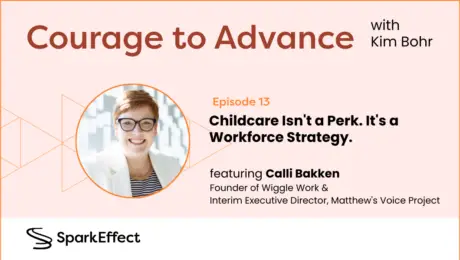


Here’s a question HR leaders rarely ask out loud: how much has your organization spent on people programs, including corporate childcare benefits, in the last three years, and how much has actually changed for the people doing the work?
Calli Bakken has spent 15 years watching companies try to answer that question with technology. She implemented HCM systems, joined a startup built around using behavioral data to create better workplaces, and believed that getting the right information in front of leadership would create the conditions for real culture change. What she found instead was that most organizations weren’t ready to act on what the data was telling them. SparkEffect’s Trust Study found that 71% of organizations faced significant disruption in the last 24 months, but only 36% emerged with stronger trust. The gap between investment and impact isn’t just anecdotal; it’s measurable.
The Problem Wasn’t the Tools. It Was the Will.
That realization set her on a path that eventually led to founding Wiggle Work, a consulting company focused on helping mid-size employers build corporate childcare that works. But before that, there were harder lessons.
What 15 Years in HR Tech Taught Her
Calli didn’t fall into HR tech by accident. She fell into HR first, discovered she cared deeply about the strategy side of people work, and then saw a gap: the people building HR systems often had no idea how HR functioned.
“I got really excited about being a hole filler,” she says. “Something needs to be done; we don’t know who’s going to do it. It’s probably me.”
What she hoped technology would do was give leaders the information they needed to build stronger cultures. What she found was a different problem entirely.
“Just because we have the information doesn’t mean that we know what to do with it. So, few companies are at a point in time where they’re willing to really operationalize the conclusions that the data is drawing.”
She also watched companies reach for what she calls the “easy button” during the COVID response era: apps, wellness platforms, and digital tools layered on top of existing stress. The result, years later, was clear.
“It doesn’t matter how great the tech is. If it adds burden to the employee’s experience and the work that they need to do, they’re not going to use it.”
Her conclusion after years in the space: technology is a stepping stone, not a solution. The real work is human.
What the Startup Years Revealed About Culture
Before founding Wiggle Work, Calli spent time in a small startup focused on employee engagement. It was scrappy in the ways she liked. It was also, ultimately, the environment that broke the spell.
What she described wasn’t dramatic. It was the slow erosion that happens when a small team is under financial pressure, priorities keep shifting, and nobody takes ownership of making sure everyone understands how their work connects to the bigger picture.
“Moving the goalpost happened a lot within that group. There wasn’t necessarily as much transparency on what we were doing, why, and what results those were returning.”
The impact was personal. She spent years doing work that was hard for others to categorize while the rest of the team focused on more concrete deliverables. The tension that created was real.
“I started saying more to my friends at the end: I’m on everyone else’s team, but no one’s on my team.” SparkEffect’s Trust Study found that manager trust is the most critical and most fragile layer during periods of disruption. What Calli described is what that looks like up close: not a single breaking point, but a slow loss of connection between effort and recognition.
She tried to leave two years before it happened. Her advice to anyone in a similar situation:
- Don’t wait for the perfect exit. Sometimes getting out matters more than getting out perfectly.
- Don’t get paralyzed by the incompatibility of the moment.
- Take the next small step: update your resume, go to a networking event, and develop the idea.
- “Every step that you take, no matter how small, is hopefully getting you toward something else that makes more sense for you.”
What Employees Actually Want
One of the clearest things Calli took from her time in HR tech was how often companies design culture strategy around their most work-obsessed employees and lose sight of everyone else.
“They want to be able to feel comfortable and confident when they come to work with what they’re doing in their work, and then they want to go home. The average person has a work life to be able to create life outside of work.”
She also described a broader shift in the employee-employer relationship, in her own words: “We had the wool pulled over our eyes. We were told a lot of things about how we show up at work is going to create a better future for us. And with the shifts in economy that we’ve seen and just how companies are structured and what companies are valuing, that’s just not how it works anymore.”
The result is real distrust. And her point is direct:
“No amount of tech is going to convince employees of those things. What’s going to convince employees is how you show up and support them and make their day-to-day experience more enjoyable, more tolerable, more functional.”
The 8 am Phone Call That Changed Everything
In early 2020, Calli became a parent. Her child had medical complexities. She was managing a referral to Mayo Clinic and was told to call at 8 am every single business day until she got on the schedule. For three and a half weeks, that was her morning routine.
“It really was such a strong experience as far as showing how much parents bring with them to work every single day. And yet we’re somehow just expected to switch it off.”
Every time her phone rang during the day, she was thinking about her child. She was calculating drive times across town. She was managing care that wasn’t close enough or quite right.
That experience made something impossible to look away from: the system wasn’t built for working families. And she was in a position to do something about it.
Why the Standard Childcare Model Breaks Down
When Calli started talking to HR professionals about corporate childcare, the conversations were good. People recognized the need. What stopped most of them was the assumption that it was too big a project to take on.
Part of that comes from how traditional corporate childcare is structured as a closed benefit for employees only. Kim Bohr, President of SparkEffect and host of the Courage to Advance podcast, pushed on this during their conversation because the assumption that something is too complex to start is one of the most common reasons organizations stall on the initiatives that would actually move the needle. Calli explained why that model keeps failing:
- Enrollment fluctuates. In one year, a company might have 10 babies. The next year, two. Infant care staffing doesn’t flex that easily.
- The math breaks down. When enrollment dips, the cost of running the center becomes unsustainable.
- The community loses out. Home-based childcare providers typically operate for four to five years before closing when their own kids start school. That’s a resource communities keep losing.
Her model addresses this by opening remaining seats to the broader community, not just employees. This keeps ratios full, sustains the operation financially, and turns the employer into something more than a benefits provider.
“By saying let’s make sure that we serve the entire community, you have access to know that you’re going to be able to fill ratios that will keep that center positively operational in a consistent manner. But you’re also able to build your reputation within that community as a staple of community support.”
Why Mid-Size, Non-Metro Companies First
Calli is deliberately targeting companies with roughly 200 to 1,000 employees, starting in non-metro communities. Her reasoning is grounded in what she has observed.
“Pretty much every incredible functional, progressive benefit — usually those who are in very affluent companies with big names who did it for showy reasons — that’s typically who has access to these innovative resources.”
She’s going the other direction. Communities that are losing people to metros have real urgency and, she noted, less red tape. The community-integrated model also opens up partnerships that a standard corporate benefit never would:
- Economic developers focused on community growth
- Local nonprofits and organizations like United Way
- Businesses willing to collaborate when a shared community resource is on the table
The Trust Signal That a Benefits Package Can’t Send
There’s a reason Calli insists on framing childcare as a workforce strategy, not a perk.
“We have an entire industry that only exists to support the world of work, and yet we’ve somehow convinced ourselves that it’s not our problem.”
When an employer makes childcare accessible, it sends a message that a gym stipend or a flexible spending account simply cannot: that employees’ full lives are seen, and that having a family isn’t something to apologize for.
“Being able to provide a tangible benefit that truly alleviates stress and brings worlds together does so much for building trust within that population. And showing them that it’s okay that I have kids.” The data backs this up. Organizations that invest in post-crisis care for their people are 6.5 times more likely to come out the other side with a clear future strategy. Childcare isn’t a soft benefit. It’s a trust investment with measurable returns.
As return-to-office expectations increase without corresponding support for caregiving realities, that trust signal matters more than ever. The organizations willing to close that gap will earn something a benefits brochure can’t manufacture: the belief that the company sees its people.
The question isn’t whether childcare is your organization’s problem. It is. The question is whether you’re willing to do something about it.
🎧 LISTEN: Hear Calli’s Full Story
Want to hear the complete conversation? Listen to Calli Bakken’s episode on Courage to Advance, where she breaks down why 15 years in HR tech convinced her that no app can replace showing up for employees, how Wiggle Work’s community-integrated childcare model solves the enrollment math that sinks most corporate centers, and her advice for HR leaders ready to treat childcare as a workforce strategy instead of a perk. [Listen to Episode →]