
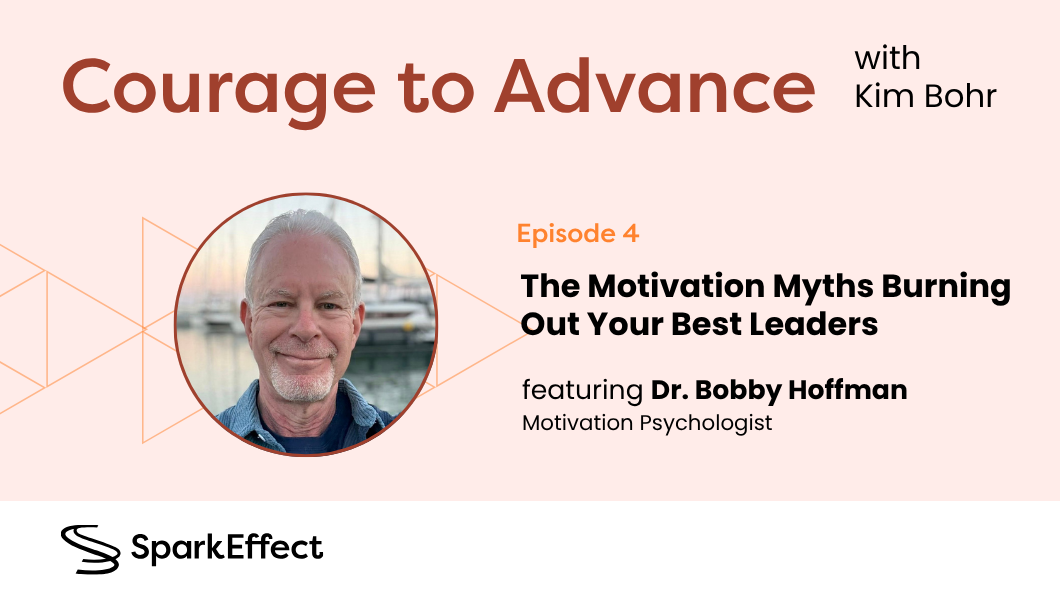





Episode 4: Featuring Dr. Bobby Hoffman
What if the advice to “follow your passion” is setting your team up to fail?
For years, thought leaders have told us that intrinsic motivation—the joy of the work itself—should drive us. Meanwhile, wanting recognition, influence, or yes, a bigger paycheck supposedly makes us shallow or selfish.
But what if that entire narrative is neurologically wrong?
In this episode of Courage to Advance, SparkEffect President Kim Bohr sits down with Dr. Bobby Hoffman, a motivation researcher who spent 22 years in corporate HR before dedicating his career to understanding what actually drives human performance. His findings challenge everything from Daniel Pink’s bestsellers to the passion-driven career advice flooding LinkedIn.
The Hidden Cost of Motivational Myths
Dr. Hoffman reveals why the passion narrative creates a dangerous cycle:
The guilt trap: When leaders feel guilty about extrinsic motivators (money, status, recognition), they develop self-doubt that leads to anxiety and even depression.
The burnout paradox: Like staying in the sun too long, pursuing passion without understanding motivational cycles leads to inevitable crashes—and most of us lack the coping strategies to recover.
The change management blind spot: During organizational disruptions, leaders focus on what they want to accomplish while ignoring employees’ mental models and self-beliefs. Result? Your best people leave.
What the Research Actually Shows
Drawing from his work with 6 million college students and decades in corporate America, Dr. Hoffman shares:
- Why extrinsic motivation (recognition, influence, material rewards) isn’t just acceptable—it’s essential
- How “momostasis” (psychological balance) works like homeostasis for your motivation
- Why most change initiatives fail: they’re built for leaders’ mental models, not employees’
- The awareness hacks that prevent motivational crashes before they happen
The trust connection: As Kim notes, SparkEffect’s research found that only 36% of organizations emerge from disruption with stronger trust. Dr. Hoffman explains why: leaders discount personal issues during change initiatives, breaking the psychological contract with their “employee clients.”
Listen
Watch
Key Takeaways for HR and Business Leaders
- Stop apologizing for extrinsic motivation. There is nothing wrong with being motivated by recognition, influence, or material rewards. These are fundamental human needs, not character flaws.
- Understand motivation cycles. Your brain requires recovery periods. Constant pursuit of goals without strategic rest leads to burnout, not sustained performance.
- Design rewards within employee discretion. The most effective motivators are those individuals can control—from favorite meals to career milestones.
- Address mental models during change. Employees with internal locus of control (belief they control their destiny) use entirely different strategies than those with external locus. Your change management must account for both.
- Build awareness practices. Ask yourself: “How might I be getting this wrong? What are other interpretations? Am I examining all evidence or just confirming what I already believe?”
About Our Guest
Dr. Bobby Hoffman is an Associate Professor at the University of Central Florida specializing in motivation science and solving the mysteries of human behavior. Before earning his PhD in Educational Psychology, he worked for over 20 years in HR management and performance consulting for GE, NBC, KPMG, and the NBA.
Dr. Hoffman has authored over 100 publications and serves on six journal editorial boards. His Psychology Today blog “Motivate!” has been viewed over 1.2 million times. He is the author of multiple books including:
- The Paradox of Passion (his latest work deconstructing motivational myths)
- Hack Your Motivation (practical strategies for sustained performance)
- Motivation for Learning and Performance
Connect with Dr. Bobby Hoffman
Resources Mentioned
- Dr. Hoffman’s books: The Paradox of Passion and Hack Your Motivation
- Dr. Hoffman’s Psychology Today articles (100+ pieces translating complex research into actionable insights)
- SparkEffect Trust Study: Download our research on how organizations can emerge stronger from disruption
Why This Matters for Organizational Trust
Dr. Hoffman’s research connects directly to SparkEffect’s findings on trust elasticity—the capacity to stretch trust across people, systems, and processes during disruption without breaking it.
When leaders misunderstand motivation, they:
- Implement change initiatives that violate employees’ self-beliefs
- Create guilt around natural human needs for recognition and reward
- Fail to build trust reserves before disruption hits
- Lose their best talent during transformations
Understanding the neuroscience of motivation isn’t just about individual performance. It’s about building organizations resilient enough to maintain trust—and even grow it—during inevitable disruptions.
Subscribe to Courage to Advance on Apple Podcasts | Spotify
Next Episode: Google vs. Barcelona: Two Paths for AI and Trust
About Courage to Advance: This podcast explores how visionary leaders are building the organizations they wish existed—companies that prove business doesn’t have to be dehumanizing while building trust elasticity that allows them to thrive through any disruption.
Courage to Advance is produced by SparkEffect, a firm specializing in organizational trust and change management as part of outplacement, executive coaching, and leadership development solutions. Learn more at sparkeffect.com.
Courage to Advance is produced by SparkEffect. New episodes drop every Tuesday.
Receive New Podcast Episodes in Your Inbox