
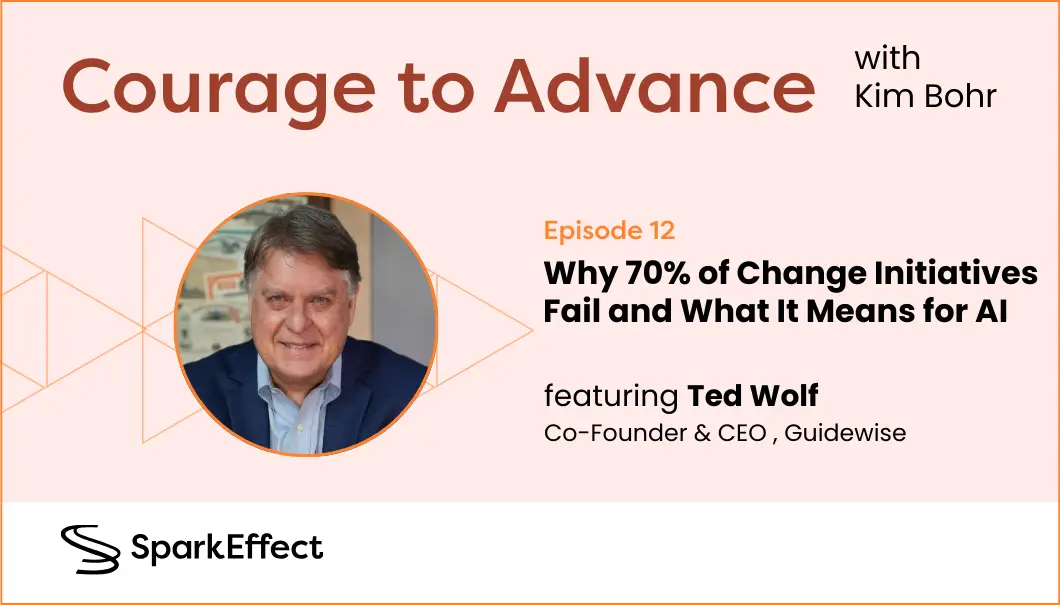





Episode 12: Featuring Ted Wolf, Co-Founder & CEO, Guidewise
Seventy percent of change initiatives fail. Not because the business case was wrong. Not because the technology didn’t work. Because organizations skip the one thing that actually determines whether change sticks: getting their people to believe in it.
Most organizations hand their AI rollout to IT, run a few pilots, and wait for productivity to climb. What they get instead: stalled adoption, frustrated employees, and a slow erosion of the trust they needed most going into this. Ted Wolf calls it “pilot purgatory,” and after overseeing more than 300 technology implementations, he’s done watching it happen.
Ted co-founded Guidewise AI to solve the problem nobody in the AI conversation is naming directly: people don’t change because of a business directive. They change when they believe the organization has their interests in mind, when they understand what this means for them personally, and when the leaders driving change have earned enough trust to ask for it. His Changeworks platform provides organizations with something no project management tool has ever offered: 40 human-centered metrics that reveal what employees actually believe, feel, and make sense of during an AI rollout, in real time.
The technology isn’t the hard part. Getting your people to actually use it is.
Listen
Watch
What You’ll Discover
- Why 70% of change initiatives fail and why your AI rollout is hitting the same wall for the same reasons
- What “pilot purgatory” is and the three questions that get your organization out of it
- The “inner game” of change: the beliefs and emotions thatdeterminewhether your people adopt or resist, regardless of what the business case says
- Why AI cannot be an ITproject andwhich departments need to be in the room from day one
- What 40 new human-centered metrics look like and why your current project management tools are leaving youoperatingin the dark
- How the “dual workforce” works and why managing AI agentsisn’tthat different from managing people
- What HR leaders need to do right now to stop being informed of the plan after it’s already been made
Episode Highlights
[00:00] Introduction: The Risk Nobody Is Measuring
Kim frames the real problem: organizations are investing heavily in AI while skipping the one variable that determines whether it works, whether their people believe it will.
[00:52] From IBM to Iron Mountain: How Ted Got Here
Ted traces the path from a $1,000 startup to 650 employees and an acquisition, and names the pattern he couldn’t stop seeing across 300+ technology implementations. The tech worked. The people didn’t change.
[04:50] Pilot Purgatory: What It Is and How You Know You’re In It
Disconnected pilots across departments. No shared business objective. No common metrics. No one is talking to each other. “When is this going to end? I have no idea. When are we going to get the payoff?”
[07:27] Why AI Breaks Trust Differently Than Other Technology
Ted and Kim connect the dots between AI-driven change and the SparkEffect Trust Study findings and why leadership behavior, not the technology itself, is what actually erodes trust during a rollout.
[09:43] The Inner Game: What Standard Change Management Misses
Most change initiatives build a project plan. Nobody builds a change adoption plan. Ted breaks down what’s actually happening in employees’ heads and why beliefs and emotions are the real implementation variable.
[16:35] HR’s Seat at the AI Table
Why AI implementations that start in IT and reach HR late are already in trouble, and what it looks like to structure the conversation right from the beginning.
[25:03] The Metrics Nobody Is Gathering
Turnover, absenteeism, and engagement scores won’t tell you what employees believe about the change happening around them. Ted walks through what Changeworks measures instead and why it changes everything about how leaders communicate during disruption.
[30:08] The Dual Workforce: What Comes Next
Ted closes with his vision for where this leads humans and AI agents working in tandem, with people managing agents the way they manage employees. “Managing 10 agents is no different than managing 10 employees.”
Key Takeaways for HR Leaders
- You don’t have an AI problem. You have a people adoption problem. Technology implementations fail at a 70% rate, not because the business case was wrong or the technology didn’t work, but because organizations don’t address what employees believe, feel, and make meaning of during change. AI is hitting the same wall. The organizations getting it right are building change adoption plans alongside their project plans, not instead of them.
- Pilot purgatory is a communication and structure failure, not a technology failure. When pilots stall, the instinct is to fix the tool. The real fix is answering the who, what, where, when, and why of change before you deploy anything and making sure those answers are consistent from the senior leadership level all the way to the frontline worker.
- Your project management tools are hiding the most important data. Asana can tell you whether tasks are on track. It tells you nothing about whether the person completing those tasks believes in what they’re doing. Belief alignment, emotional patterns, and meaning-making are the metrics that predict adoption. Without them, you’re managing in the dark.
- HR’s role in AI isn’t changing communication — it’s implementation architecture. AI touches every department’s data and every employee’s sense of career security. Organizations that bring HR in after the plan is built are already behind. The leaders getting this right aren’t asking HR to message the change; they’re asking HR to help design it.
- Trust erodes fast during AI rollouts — and recovers slowly. Ted’s observation maps directly to SparkEffect’s research: you can spend years building organizational trust, and one poorly handled decision can undo it. The middle management layer is where AI change initiatives most commonly break down, and where trust damage is hardest to repair.
- The dual workforce is coming. Start building the culture for it now. Managing AI agents requires the same fundamentals as managing people: clear onboarding, defined policies, accountability structures, and quality checks. Organizations that start building those muscles now will absorb the disruption. Organizations that wait will be playing catch-up in a much higher-stakes environment.
About Our Guest
Ted Wolf is the founder of Guidewise AI and creator of the Changeworks platform. He spent 18 years building a technology staffing company with his brother, starting with $1,000 and no outside funding, scaling to 650 billable employees across 13 offices, and ultimately being acquired by Iron Mountain Corporation. After the acquisition, Ted founded a coaching and change management practice and went on to oversee more than 300 ERP and technology implementations, giving him a direct view of why people adoption is where every technology project actually wins or loses. He co-founded Guidewise AI with his son, combining decades of organizational change expertise with AI implementation technology designed to meet people where they actually are.
Connect with Ted Wolf
Guidewise Website: guidewise.ai
LinkedIn: Ted Wolf – https://www.linkedin.com/in/tedwolftwo/
Email: ted@guidewise.ai
Notable Quotes
Ted Wolf:
“You can spend years earning trust, but it really takes one decision and one bad day to completely destroy all the trust that was put in place.”
“If you don’t orchestrate agents properly, all you’re going to do is replicate and speed up the chaos in the organization much faster.”
“The person managing the project has all kinds of data on the project, but nothing about the end user. They’re operating in the dark.”
“Implementing AI with the human aspect reduces the risk of failure.”
Kim Bohr:
“We found that AI-driven system changes were the most common disruptor organizations are facing, and yet they weren’t the biggest trust breaker. Leadership turnover and job redesign hit trust much harder. So, what does that tell us about why AI implementations actually fail?”
Related Resources
- SparkEffect Trust Study – Research showing that 71% of organizations faced disruption in the last 24 months, but only 36% emerged stronger (https://info.sparkeffect.com/trust-study-2025-download)
Receive New Podcast Episodes in Your Inbox
About Courage to Advance
Courage to Advance explores how visionary leaders are building the organizations they wish existed, companies that prove business doesn’t have to be dehumanizing. Hosted by Kim Bohr, President and COO of SparkEffect, each episode features executives who refuse to accept that traditional corporate practices are inevitable, sharing the experiments, resistance, and breakthrough results of choosing human flourishing alongside business success.
Subscribe anywhere you listen to podcasts. You can find links to all platforms HERE!
Visit: couragetoadvancepodcast.com for free resources and tools.