
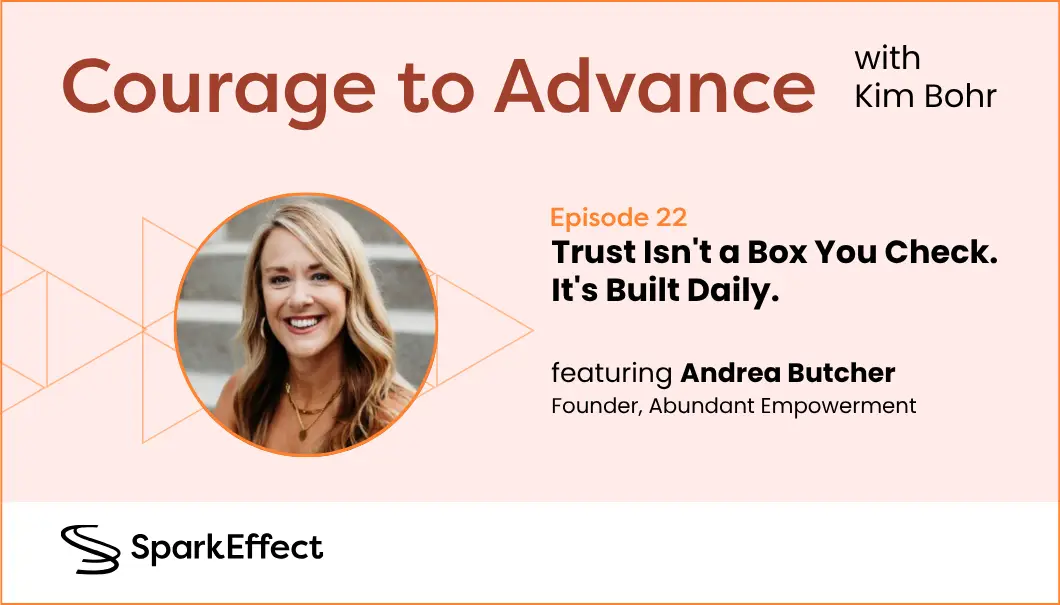





Episode 22: Featuring Andrea Butcher | Founder, Abundant Empowerment
Trust is the thing every leader says they want more of, and the thing most are quietly getting wrong. The common belief is that you build it through competence or charisma: prove you are capable, earn people’s confidence, then move on to the work. Then the team goes quiet, the executive room gets political, and the organization stops believing what leadership says.
What most leaders miss is that trust is not a milestone you reach and bank. Andrea Butcher, an executive coach who has spent years inside executive and leadership teams, names the real dynamic plainly: every communication, every email, every text, every Slack message is either building trust or eroding it. The breakdowns she sees most often are not dramatic betrayals. They are unmet expectations, assumptions left unspoken, and leaders who are too in the grind to notice the small moments where trust quietly slips.
Andrea Butcher is the founder of Abundant Empowerment and host of the Being at Work podcast. Her work centers on the being of leadership rather than the doing: equipping leaders to be more of who they already are, instead of performing against a list of competencies. In this episode, she joins host Kim Bohr to continue a conversation that began when Kim appeared on Being at Work to discuss SparkEffect’s State of Organizational Trust research. This time they flip it, focusing on how trust actually gets built.
Along the way, Andrea draws a sharp line between predictive trust (will you do what you said) and vulnerability-based trust, the messier, relational kind that actually builds connection. The conversation covers dropping the armor in the executive room, catching the stories we tell ourselves about difficult colleagues, circling back when something doesn’t land, and treating the hardest team dynamics as a portal to growth rather than a problem to manage.
Listen
Watch
What You’ll Discover
- Why predictive trust is only the surface, and what vulnerability-based trust adds underneath it
- How a driven, fast-paced CEO built trust with a team he barely knew by deliberately holding back and seeking out the quieter voices
- Why a leader’s strongest trait can tip into a liability, and why the fix is intentionality, not a new skill
- What labeling a difficult colleague a “bulldozer” actually costs you, and the question that rebuilds the relationship instead
- Why dysfunction on a team is normal, and what separates teams that name it from teams that dance around it
- The onboarding instinct that backfires, and the simple thing that builds connection faster than any form
- Why every interaction either strengthens or erodes trust, drawn from a story Andrea could not even remember until a former report told her
Episode Highlights
[00:00] The trust most leaders get wrong: Kim opens on why trust is the one thing every leader wants more of, and the one most are quietly getting wrong.
[01:43] Why trust is the conversation right now: Andrea frames leadership as a relationship and introduces vulnerability-based trust as distinct from predictive trust.
[04:13] Taking the armor off: How authenticity, not proving yourself, is what actually forms trust in the executive room.
[05:08] The healthcare-tech CEO story: A naturally driven CEO chooses restraint, seeks out quieter leaders, and builds connection against his own grain.
[09:00] Stop labeling, start asking: How calling a difficult leader a name disempowers you, and what curiosity about their pressure does instead.
[12:53] What a dysfunctional team looks like: The signals Andrea reads first: who is unwilling to tell the truth in the group, and who dances around it.
[24:52] The report who carried a hurt for years: Andrea’s story of learning, long after the fact, how a forgotten moment eroded someone’s trust in her.
Key Takeaways for HR and People Leaders
Trust is built or eroded in every interaction, not earned once.
Leaders tend to treat trust as a threshold: cross it and you are done. Andrea’s reframe is that the smallest, most forgettable moments (an email, a Slack reply) are where trust quietly accrues or drains. The implication is daily attention, not periodic effort.
Vulnerability-based trust beats predictive trust.
Doing what you said matters, but it is the surface. The deeper layer is the willingness to drop the armor, name your struggles, and be honest in the room. That is what makes people want to engage.
Your strongest trait is your biggest blind spot.
The driven CEO who connects through restraint shows that growth is rarely about adding a skill. It is about noticing when a strength is over-firing and choosing intentionality in the moment. Andrea calls it an intentionality issue, not a capability issue.
Labeling a difficult colleague disempowers you.
The moment you decide someone is a bulldozer, you stop being curious about the pressure driving their behavior, and you forfeit your ability to build trust with them. The move is a question, not a verdict.
Dysfunction is normal; avoiding it is the problem.
Every team has friction. What distinguishes strong teams is the willingness to name the dysfunction and work through it together, rather than rationalize and dance around it. Psychological safety is what makes that possible.
Connection is built in conversation, not onboarding forms.
Knowing the people and pets that matter in someone’s life does more for trust than any structured plan. Leaders make it harder than it needs to be.
Notable Quotes
Andrea Butcher:
“Every communication, every email, every text, every slack, everything I put out there is either building or eroding.”
“Leadership is a relationship.”
Kim Bohr:
“When I think back in my own career, I’ve grown the most” from the more challenging situations. That’s where I tell people that sometimes when they’re going through those situations… this is where you’re growing the most”
“It’s few people that walk in with that as their goal every day. So it’s understanding why we’re perceiving it that way too.”
About Our Guest
Andrea Butcher is an executive coach, keynote speaker, and the founder and Chief Visionary Officer of Abundant Empowerment, a firm focused on developing leaders who live fully, lead consciously, and create the conditions for others to do the same. She is also the founder of Next Gen Talent, a program built to equip emerging HR leaders for success. She works closely with executive and leadership teams, co-creating experiences that give leaders the space to tell the truth and do the harder, internal work of leadership over time.
She hosts the Being at Work podcast, where she explores the being of leadership, the internal awareness and intentionality behind how leaders actually show up. Her approach centers on equipping leaders to be more of who they already are, rather than performing against a generic set of competencies, and on the difference between predictive trust and the vulnerability-based trust that builds real connection.
A certified coach trained through the Institute for Professional Excellence in Coaching (iPEC), Andrea is also the author of The Power in the Pivot (Red Thread Publishing, 2022) and HR Kit for Dummies (Wiley, 2023).
Connect with Andrea Butcher
About Courage to Advance
Courage to Advance explores how visionary leaders are building the organizations they wish existed, companies that prove business doesn’t have to be dehumanizing. Hosted by Kim Bohr, President and COO of SparkEffect, each episode features executives who refuse to accept that traditional corporate practices are inevitable, sharing the experiments, resistance, and breakthrough results of choosing human flourishing alongside business success.
Subscribe anywhere you listen to podcasts. You can find links to all platforms HERE!
Visit: couragetoadvancepodcast.com for free resources and tools.
Related Resources
- SparkEffect Trust Study — https://info.sparkeffect.com/trust-study-2025-download
- Trust in Turbulence: A Leader’s Field Guide — https://info.sparkeffect.com/leaders-field-guide
- SparkEffect Executive Coaching — https://sparkeffect.com/what-we-do/executive-coaching/
- SparkEffect Leadership Development Programs — https://sparkeffect.com/what-we-do/leadership-development-programs/
Receive New Podcast Episodes in Your Inbox