
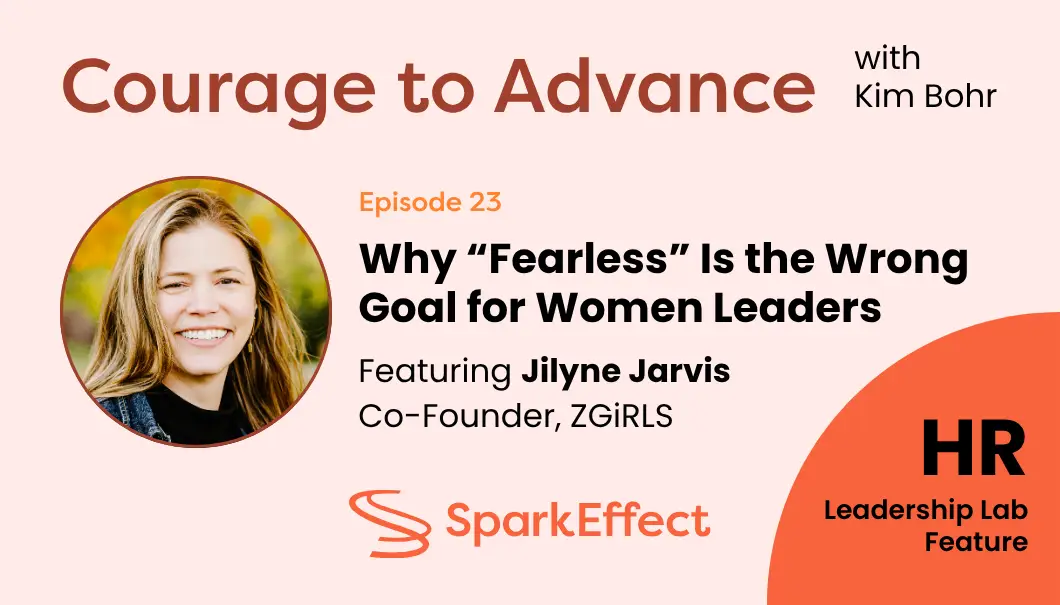





Episode 23: Featuring Jilyne Jarvis, Co-Founder & Executive Director, ZGiRLS
The confidence gap that holds women back in leadership does not start in the workplace. It starts around age 14. That is the case Kim Bohr, CEO of SparkEffect, and her guest Jilyne Jarvis make in this episode of Courage to Advance, and once you see the line connecting the two, you cannot unsee it.
Jilyne knows the gap from the inside. She was a ski racer winning at the highest junior levels, the kid who looked unshakable on the podium. Off it, she had no idea what she was worth. Her whole sense of value was wired to achievement, and when the achievement paused, so did her sense of self. Years later, coaching girls, she realized the thing she thought was uniquely wrong with her was happening to all of them. No one was teaching anyone how to build confidence from the inside.
So in 2014 she built the program she had needed. ZGiRLS teaches girls 11 to 14 the same mental tools elite athletes use to handle pressure, doubt, and fear. The twist that makes it work: the coaches are Olympic, collegiate, and professional women athletes who say out loud that they feel afraid too. Confidence, in Jilyne’s framing, is not a trait you are born with or without. It is a skill you build through action, and that reframe is exactly why it matters to anyone responsible for developing leaders.
Because the same patterns play out at the top of the org chart. The capable woman who will not apply until she meets every requirement, who reads her own nerves as a stop sign, who waits to feel ready: those are 14-year-old habits that never got named. This conversation covers why the window of 11 to 14 matters, why “fearless” is the wrong goal to set for anyone, and what leaders and parents can actually do, starting this week, to model a healthier relationship with fear.
Listen
Watch
What You’ll Discover
- Confidence is a skill you build, not a trait you’re born with
- Why “fearless” is the wrong goal, and what elite athletes do instead
- How a girl’s confidence dip at 11 to 14 becomes a woman’s hesitation at work
- Why “I won’t apply until I’m 100% qualified” starts young, and can be unlearned
- The “yet” move: model the work out loud instead of lecturing
- Why a leader saying “I’m working on this too” is a strength, not a weakness
- What almost quitting her own company taught Jilyne about self-imposed labels
Episode Highlights
[00:00] A leadership conversation that starts in middle school Kim connects the version of us that started shrinking at 14 to the leaders we became, and names why this is a talent-pipeline conversation, not just a parenting one.
[03:06] What elite racing taught her about the mental game: Racing the Europa Cup for the U.S. Ski Team at 19, and what shifted when the environment went from team-spirited to pure individual pressure.
[07:17] “There’s nothing wrong with me”: The realization, while coaching, that the self-doubt Jilyne carried was universal rather than personal, and the founding insight behind ZGiRLS.
[13:07] Why middle school, why 11 to 14: The developmental window when a girl can grasp that she has thoughts but is not her thoughts, caught just before she starts looking outward for validation.
[14:39] Why athletes deliver the message: “You think I’m standing there fearless. I’m not.” Why admitting the fear, rather than hiding it, is what makes the message land.
[16:00] What parents and leaders actually model: The “yet” move: catch the fixed-mindset self-talk, say “I just haven’t figured this out yet,” and demonstrate that working on it is human, not weak.
[21:05] What she would tell her 14-year-old self, and “do it scared”: The two things she needed to hear, the origin of the mantra she now leads by, and why bravery, not fearlessness, is the actual goal.
Key Takeaways for HR and People Leaders
The confidence gap in your leadership pipeline did not start at work.
The hesitation you see in capable women, around visibility, risk, and self-advocacy, is the same pattern that takes hold at 11 to 14. Treating it as an adult performance problem misses where it forms. Naming it as a learned pattern is what makes it something development can address, which is the premise behind how SparkEffect approaches Building the Leadership Bench.
Confidence is a skill, which means you can develop it.
If confidence were fixed, coaching toward it would be a waste of budget. Jilyne’s whole model rests on the opposite: confidence is built through repeated action and specific tools. That is the same logic behind SparkEffect’s Leadership Development and Executive Coaching work, where capability is built deliberately rather than assumed.
“Fearless” is the wrong standard to set for your people.
The leaders and athletes your team admires are not without fear. Holding up fearlessness as the bar teaches people to read their own nervousness as a reason to stop. Bravery is the more useful standard: act while the fear is present. “Do it scared” is a practical reframe for anyone hesitating at the edge of a stretch assignment.
Psychological safety is set by what leaders model, not what they announce.
When a leader says “I haven’t figured this out yet” or “I was wrong,” they show the team what is safe to say. Psychological safety is one of the four pillars of organizational trust in SparkEffect’s research, and this episode is a clinic in demonstrating it rather than declaring it.
Visible women in leadership change what the next person believes is possible.
Jilyne’s point from her Seattle Sports Commission work maps straight onto your org chart: when people can see women leading, it rewrites what others believe they can do. Representation is not a nicety. It is how belief about possibility spreads through a workforce.
Self-imposed labels cap performance more quietly than any external barrier.
Jilyne nearly shut down her own organization because she could not see herself as a CEO, all while teaching girls to drop that exact kind of label. The question she now asks, and a sharp one for any leader: what labels and self-built blocks are quietly capping your highest-potential people?
Notable Quotes
Jilyne Jarvis:
“When I was standing on the top of a podium, I did. But when I wasn’t, I had absolutely no idea what my value was in the world. All my self worth was wrapped up in achievement.”
“You think I’m standing there fearless. I’m not. And don’t think that if you’re afraid, you’re not ready either, because you are.”
“Just because you think it doesn’t make it true.”
Kim Bohr:
“Having been a middle school girl at one time, I recognize the challenges that this age group faces, and that really can derail women long into their professional careers.”
“We’re doing a lot of these things as women leaders and not even recognizing it.”
“Do it scared is a very good mantra I think we all could benefit from.”
About Our Guest
Jilyne Jarvis is a seven-time NCAA All-American and a retired U.S. Ski Team member. She competed at the elite level before moving into tech recruiting, where she started noticing the same self-limiting patterns in accomplished professionals that she recognized from her own years in sport.
In 2014, Jilyne founded ZGiRLS to teach girls 11 to 14 the mental tools elite athletes use to build confidence, resilience, and self-worth. Olympic, collegiate, and professional women athletes deliver the program and share their own experiences of doubt and fear. ZGiRLS runs on a 100% scholarship acceptance model: it has never turned away a girl who needs financial support, and over 84% of participants attend for free.
Named to the Puget Sound Business Journal’s “40 Under 40,” Jilyne mentors entrepreneurs through the University of Washington’s Foster School of Business and Start-Up Accelerator, advises the Women’s Entrepreneurial Leadership Program, and took on the role of Seattle Sports Commissioner in 2025.
Connect with Jilyne Jarvis
Website: https://zgirls.org/
LinkedIn: https://www.linkedin.com/in/jilyne/
Email: jilyne@zgirls.org
Social: @gozgirls
ZGiRLS partners with companies, donors, and supporters to keep its programs free for the girls who need them. Leaders whose organizations want to back this work can reach Jilyne directly at https://zgirls.org/ or jilyne@zgirls.org.
About Courage to Advance
Courage to Advance explores how visionary leaders are building the organizations they wish existed, companies that prove business doesn’t have to be dehumanizing. Hosted by Kim Bohr, President and COO of SparkEffect, each episode features executives who refuse to accept that traditional corporate practices are inevitable, sharing the experiments, resistance, and breakthrough results of choosing human flourishing alongside business success.
Subscribe anywhere you listen to podcasts. You can find links to all platforms HERE!
Visit: https://sparkeffect.com/sparkeffect-podcast-courage-to-advance/ for free resources and tools.
Related Resources
- SparkEffect Trust Study — https://info.sparkeffect.com/trust-study-2025-download
- Trust in Turbulence: A Leader’s Field Guide — https://info.sparkeffect.com/leaders-field-guide
- SparkEffect Executive Coaching — https://sparkeffect.com/what-we-do/executive-coaching/
- SparkEffect Leadership Development Programs — https://sparkeffect.com/what-we-do/leadership-development-programs/
Receive New Podcast Episodes in Your Inbox