
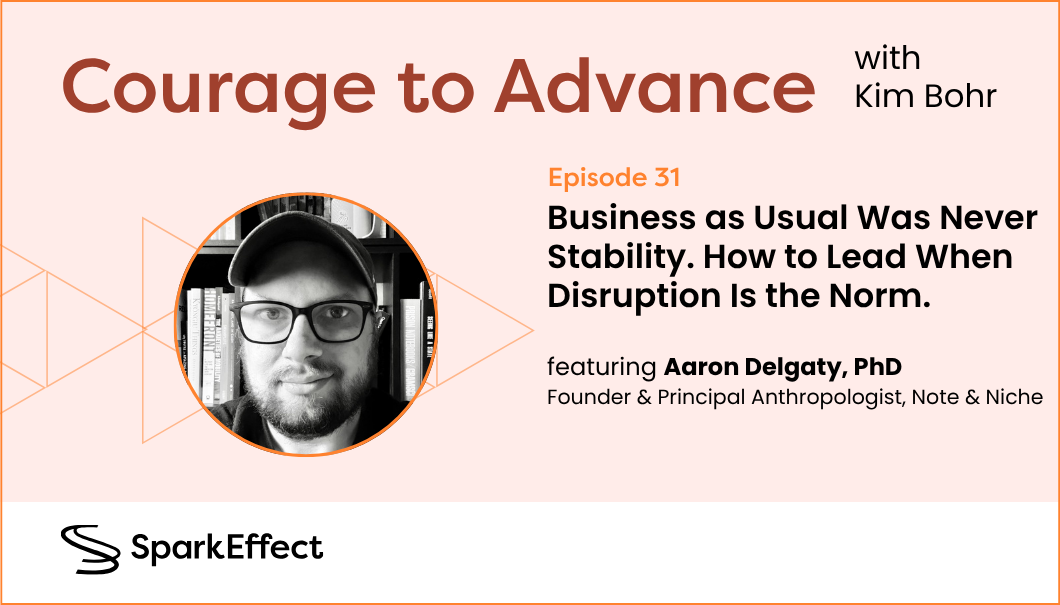




Episode 31: Featuring Aaron Delgaty, PhD, Cultural Anthropologist and Founder, Note & Niche
Most leaders are still waiting for things to settle down. The research says they will be waiting a long time. In year two of SparkEffect’s study of organizational trust, 85% of people reported a significant disruption in the past two years, up from 71% the year before. Disruption is not the storm that passes. It is the weather.
The reflex is to treat that as a stability problem and to reach for another training or another all-hands. What the data shows is a support problem, and a lopsided one. No single form of help reached more than a third of people, and most received only one or two kinds. The most common response, a direct manager stepping in, sat at 34%. So the whole weight of holding trust together during change lands on one person, the direct manager, who is being handed AI and told to figure it out at the same time. When that person is stretched thin, trust does not fail loudly. It wears through.
Aaron Delgaty, PhD is a cultural anthropologist, ethnographer, and the founder of Note & Niche, a research and strategy studio for mission-driven organizations. As SparkEffect’s research partner, he led year two of Trust in Turbulence, the 2026 State of Organizational Trust report. His gift is taking the language leaders use on autopilot and turning it over until it means something. “Business as usual” stops being a claim about stability and becomes what it always was, a measure of how much disruption people can absorb and still feel steady.
Watch
Listen
🎧 LISTEN: Hear Aaron Delgaty’s full conversation with Kim Bohr
Want the full episode? Listen to Aaron Delgaty, PhD on Courage to Advance, where he and host Kim Bohr break down why business as usual was never stability, why your managers are carrying more than you think, and how trust quietly moves revenue, retention, and reputation.
In this conversation, Aaron and host Kim Bohr, CEO of SparkEffect, get specific about who is carrying the load, why quality of support beats quantity, and how trust shows up in the numbers leaders actually track. It is a clear-eyed look at the everyday disruptions that decide whether an organization holds together, and a strong case that trust is not soft, it is measurable, and it moves the business.
What You’ll Discover
- Why “business as usual” was never a promise of stability, and what that reframe changes about how you lead through constant change
- Why most disruptions get one or two kinds of support at best, and what that thin coverage quietly costs in trust
- Why a resource employees do not know about might as well not exist, and how perception, not policy, drives trust
- Why AI landed twice as hard on managers, and what happens when you hand someone a tool and walk away
- Why the direct manager became the single load-bearing point of trust, and where that leaves a stretched middle
- Why one high-quality response beats a pile of mediocre ones, and how quality moves the metrics that matter
- What employees actually ask their manager during change, and why it looks more like a camp counselor than a commander
- How trust shows up in revenue, retention, and reputation, and why it belongs on your dashboard like any other KPI
Episode Highlights
[00:00] Disruption as the operating condition. Kim frames the year two findings and welcomes Aaron back, setting up why constant disruption is now the baseline rather than the exception.
[02:48] Business as usual was never stability. Aaron reframes a phrase everyone uses without thinking, arguing it is a measure of our comfort in a system that is always changing, not a return to calm.
[05:50] Intervention is thin on the ground. The finding that no single form of support reached more than a third of people, illustrated by a hospital that stocks only band-aids and antibiotics and hopes it is enough.
[09:19] Why AI hits managers twice as hard. Kim and Aaron on the pressure managers carry, expected to steady everyone else while figuring out a new tool that was thrust on them too.
[21:46] The manager who has your back. Why employees name their direct manager as their advocate, the spike in trust when a manager fights for them, and why that is not a hill worth fighting your people on.
[25:01] Quality over quantity, and the four Rs. How a high-quality intervention lifts trust above baseline, and how trust moves revenue, retention, and reputation with both customers and the industry.
[29:49] Trust is not mysterious. Aaron’s case that trust behaves like any relationship, measurable and responsive, going down when a company does something bad and up when it does something good.
[32:44] Sweat the small stuff. Aaron’s closing argument that it is the little things, not the giant catastrophes, that define the relationships inside an organization.
Key Takeaways for HR Leaders
- Disruption is the baseline now, not the exception. 85% of people faced a significant disruption in the past two years, up from 71%. Stop planning for a return to calm and start building for a steady state that has disruption built into it.
- Your managers are a single point of failure for trust. Trust runs strongest between a manager and their direct reports, and it fractures when disruptions are mishandled. One person holds the tension of that relationship, and you have handed them AI on top of everything else. Resource the middle before it wears out.
- Coverage is thin, so quality has to carry the load. No single intervention reached more than a third of people, and most got only one or two. You will not conjure more capacity, so make the few responses you can offer genuinely good ones. Quality moves the metrics more than quantity does.
- A resource nobody knows about does not exist. The study measured perception, not policy. If your people cannot name the support available to them, it is not protecting trust. Audit what employees actually know, not what is on the books.
- Trust is measurable, and it moves the business. It shows up in revenue, retention, and reputation with both customers and the industry. Put trust on the dashboard and treat a mishandled disruption as the P&L risk it is.
- Sweat the small stuff. It is the everyday micro-disruptions, not the headline crises, that decide whether trust holds. Equip managers for the small moments and the big ones get easier.
About Our Guest
Aaron Delgaty, PhD is a cultural anthropologist and ethnographer whose work centers on worker and workplace resilience, why people do what they do at work and what happens when organizations lose sight of the humans inside them. He earned his doctorate from the University of North Carolina at Chapel Hill in 2020, teaches research methods and anthropological theory, and is the founder and principal anthropologist of Note & Niche, a research and strategy studio for mission-driven organizations.
He is the author of Working Relationships: Crisis and Resilience at the Heart of Employee Experience. For SparkEffect’s State of Organizational Trust research, Aaron co-designed the Trust Performance Index and led the social science methodology and analysis, including year two of the study discussed in this episode.
Connect with Aaron Delegate, PhD
- LinkedIn: https://www.linkedin.com/in/adelgaty/
- Book (Amazon): Working Relationships, https://a.co/d/iLPmqvb
- Note & Niche: https://www.noteandniche.com/
Notable Quotes
Aaron Delgaty, PhD: “We should understand business as usual as the measure of our comfort in a system that is constantly changing, rather than some kind of impossible notion of stability.”
Aaron Delgaty, PhD: “You should sweat the small stuff, because it is all of the little things. It’s not the giant catastrophes that define the relationships within your organization. It’s how you deal with the little things.”
Kim Bohr: “Disruption is not the exception. It is the new operating condition that we all need to accept.”
Kim Bohr: “This isn’t about more training. This is about the right type of tools needed.”
Related Resources
SparkEffect Trust Study 2026 — https://info.sparkeffect.com/trust
- Aaron’s first appearance, Manager Trust Under Fire (Courage to Advance): https://sparkeffect.com/homepage/manager-trust-under-fire-the-hidden-leadership-vulnerability/
SparkEffect Executive Coaching — https://sparkeffect.com/what-we-do/executive-coaching/
SparkEffect Leadership Development Programs — https://sparkeffect.com/what-we-do/leadership-development-programs/
Science of Trust eBook: https://sparkeffect.com/the-science-of-trust-ebook/
SparkEffect CEO and Board Advisory: https://sparkeffect.com/what-we-do/ceo-board-advisory/
- Connect with the Host: Kim Bohr – https://www.linkedin.com/in/kimbohr/
About Courage to Advance
Courage to Advance explores how visionary leaders are building the organizations they wish existed, companies that prove business doesn’t have to be dehumanizing. Hosted by Kim Bohr, President and COO of SparkEffect, each episode features executives who refuse to accept that traditional corporate practices are inevitable, sharing the experiments, resistance, and breakthrough results of choosing human flourishing alongside business success.
Subscribe anywhere you listen to podcasts. You can find links to all platforms HERE!
Visit: https://sparkeffect.com/sparkeffect-podcast-courage-to-advance/ for free resources and tools.
Receive New Podcast Episodes in Your Inbox