
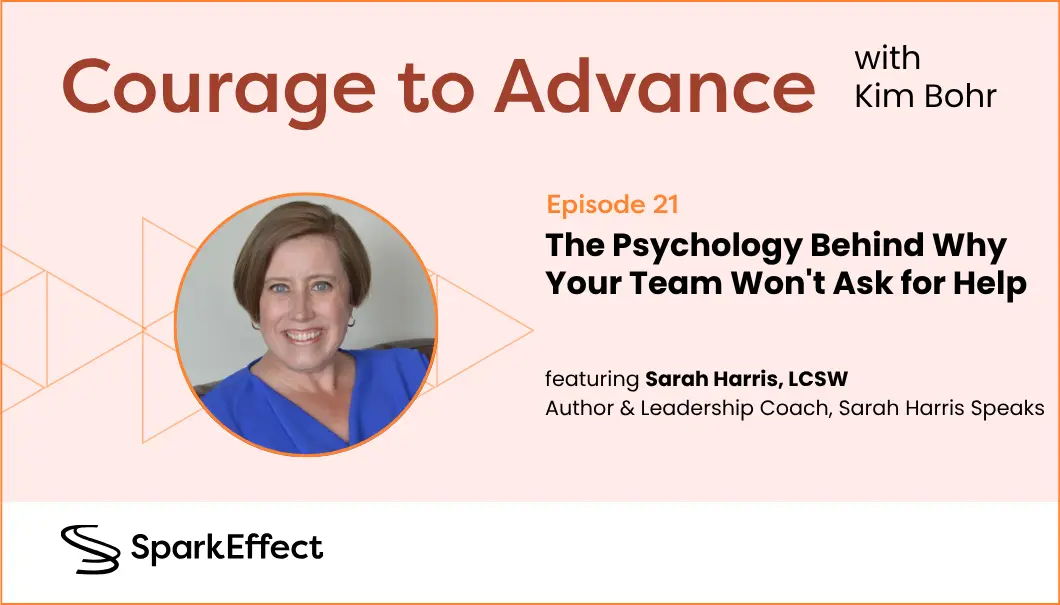





Episode 21: Featuring Sarah Harris | Licensed Clinical Social Worker, Speaker, and Author
Most organizations say they support employee wellbeing. The policies are on the books, the EAP is in the benefits package, and the language is in the job postings. But what happens when an employee can only see their therapist between 8:30 and 3:30, and every available window conflicts with a standing meeting, an all-hands, or a manager who needs the coverage? The policy says one thing. The experience says something else entirely.
That gap is where trust quietly erodes. Not in a dramatic failure, but in the small moments when someone realizes that asking for help will cost them something they can’t afford to lose. A promotion timeline. A perception of competence. The simple feeling of not being a problem. Sarah Harris has spent more than 20 years on the other side of that equation, sitting across from people in therapy who are learning new skills and then walking back into workplaces that make those skills nearly impossible to use.
Sarah is a licensed clinical social worker who still maintains an active clinical practice while also helping leaders build healthier workplace cultures. Her book, The Culture Garden: A Leader’s Guide to Growing a Thriving Workplace from the Ground Up, provides practical, desk-ready scripts that leaders can read at their desk and use in the hallway five minutes later. Her perspective comes from the treatment room, not the boardroom, and that clinical lens is what sets her recommendations apart.
In this episode, Sarah and Kim Bohr talk about why the word “accommodation” pushes people away from asking for help, what happens neurologically when you startle a colleague by approaching from behind, how a 20-minute message-checking rule transformed one IT worker’s productivity, and why the smallest, free changes often produce the biggest results.
Listen
Watch
What You’ll Discover
- Why your wellbeing policy may be communicating the opposite of what you intend, and how to audit the gap between stated values and operational reality
- What happens in the brain when a perceived threat is triggered at work, and why your colleague is four sentences behind the conversation before you realize it
- How replacing “What accommodations do you need?” with “What would feel most supportive to you?” changes the entire nervous system response
- The cross-training blind spot that makes your PTO policy hollow for the one person who can’t actually use it
- Why defining what “timely” means for Slack responses is one of the simplest, highest-impact changes a team can make
- How approaching with curiosity holds people accountable while opening the door to understanding at the same time
- What two-way transparency looks like during disruption, and why being honest about what you don’t know kills rumors before they harden into fear
Episode Highlights
[00:00] Introduction: Kim welcomes Sarah Harris and frames the conversation: what if the best way to boost productivity, trust, and retention didn’t require a budget, a new policy, or another meeting?
[01:23] From frustration to mission: Sarah shares how watching her therapy clients struggle to use new skills in unsupportive workplaces pushed her into workplace culture consulting.
[04:12] The costs that aren’t spoken:Why employees weigh stigma, promotion risk, and opportunity loss before asking for help, and how casual mental health language reinforces that silence.
[06:47] The policy-to-practice disconnect:Two examples: the therapist’s office hours that don’t fit the employer’s schedule, and the employee who couldn’t take Fridays off because she was the only one trained to run a weekly report.
[10:53] From “accommodation” to “support”: Why the technically correct word carries an implied message that you’re a burden, and how one word swap changes whether someone’s nervous system reads the interaction as threatening or collaborative.
[13:29] The 20-minute rule.: An IT worker with clinical anxiety whose ticket-clearing speed skyrocketed when he stopped responding to every ping in real time and checked messages on a 20-minute cycle instead.
[16:38] Defining “timely” and coding urgency: How setting clear expectations for messaging response times gives people permission to protect their focus. Sarah’s “Not an emergency / 911” system with her 83-year-old father as a real-world model.
[24:26] Approaching with curiosity: The management practice that holds people accountable while opening the door to understanding. A detailed example of how to have the conversation when an employee’s attendance pattern shifts.
[28:57] What’s happening in the nervous system: The neuroscience of perceived threat: how the amygdala fires before the prefrontal cortex catches up, why the body prepares to fight or run before the brain can process language, and why someone is four sentences behind before their brain comes back online.
[36:43] Two-way transparency during disruption: Be honest about what you know and what you don’t know. How that approach cuts off rumors before they harden into assumptions.
Key Takeaways for HR Leaders
1. Your wellbeing policy may be sending a message you didn’t write.
When an employer advertises support for health and wellbeing but restricts when employees can access care, the lived experience contradicts the stated value. The same applies to PTO policies that fall apart when someone is the only person trained to do their job. Auditing the gap between policy intent and operational reality is a trust intervention, not just an HR exercise.
2. The language of support matters more than the language of compliance.
“Accommodation” is the correct word. It is also a word that makes people feel like a burden. Replacing “What accommodations do you need?” with “What would feel most supportive to you?” changes the nervous system response to the conversation. It costs nothing and signals that help is collaborative, not clinical.
3. Perceived threats don’t wait for context.
The brain’s threat response fires before conscious processing begins. When someone is startled at their desk, their amygdala has already sent the body into fight, flight, or freeze before the prefrontal cortex can assess the situation. Small environmental adjustments, like rotating desks so people can see the door, clearing your throat before entering an office, and keeping your hands visible, reduce these activations without requiring anyone to disclose their history.
4. Curiosity is accountability and compassion at the same time..
When an employee’s patterns shift, approaching with curiosity, naming what you’ve observed, not prying into personal details, and asking what support would help, gives them the opportunity to share or not. It holds the standard while opening the door. The question Sarah asks managers first: “What is going on in the workplace culture that you don’t feel you can make this decision?”
5. Transparency during disruption requires saying what you don’t know, not just what you do.
Most leaders share what they can and stop there. Sarah’s framework adds the second layer: name the questions you can’t answer yet. “We believe the new organization will make some structural changes. We have not been told yet at what levels those will be impacted.” That sentence, spoken out loud, cuts off the rumor cycle before it starts.
Notable Quotes
Sarah Harris:
“It really came out of a frustration… so many of my clients were struggling with being able to utilize the skills that were learning in therapy in their workplaces.”
Kim Bohr:
“That’s the illusion of inclusion. It may be well intended, but the realities of how the world is working isn’t being considered.”
About Our Guest
Sarah Harris is a licensed clinical social worker with more than two decades of experience in mental health practice. She maintains an active clinical caseload while also working with organizations as a speaker, leadership coach, workshop facilitator, and workplace culture consultant. Her focus is helping leaders understand the psychological dynamics that shape whether employees feel safe enough to do their best work.
Sarah’s book, The Culture Garden: A Leader’s Guide to Growing a Thriving Workplace from the Ground Up, translates her clinical expertise into practical, script-ready tools that leaders can apply the same day. Her approach integrates the latest research and science in mental health, making complex concepts accessible to leaders at every level. Her recommendations are grounded in her firsthand work with therapy clients who navigate mental health challenges in workplace environments that are often unintentionally working against them.
Connect with Sarah Harris
- Website: https://www.sarahharrisspeaks.com
- Book: The Culture Garden: https://www.amazon.com/dp/B0FKD8HXF5
- Leadership Culture Brief (Free Resource): Access Sarah’s short executive briefing, Fix the Soil First, along with a Culture Soil Audit to help you evaluate the conditions shaping your workplace culture. https://mailchi.mp/sarahharrisspeaks/leadership-culture-brief
Related Resources
- SparkEffect Trust Study – Research showing that 71% of organizations faced disruption in the last 24 months, but only 36% emerged stronger (https://info.sparkeffect.com/trust-study-2025-download)
- The Culture Garden by Sarah Harris: https://www.amazon.com/dp/B0FKD8HXF5
- Leadership Culture Brief: Fix the Soil First + Culture Soil Audit: https://mailchi.mp/sarahharrisspeaks/leadership-culture-brief
- The SparkEffect Trust Study: https://info.sparkeffect.com/trust-study-2025-download
- Sarah Harris Speaks: https://www.sarahharrisspeaks.com
About Courage to Advance
Courage to Advance explores how visionary leaders are building the organizations they wish existed, companies that prove business doesn’t have to be dehumanizing. Hosted by Kim Bohr, President and COO of SparkEffect, each episode features executives who refuse to accept that traditional corporate practices are inevitable, sharing the experiments, resistance, and breakthrough results of choosing human flourishing alongside business success.
Subscribe anywhere you listen to podcasts. You can find links to all platforms HERE!
Visit: couragetoadvancepodcast.com for free resources and tools.
Receive New Podcast Episodes in Your Inbox