
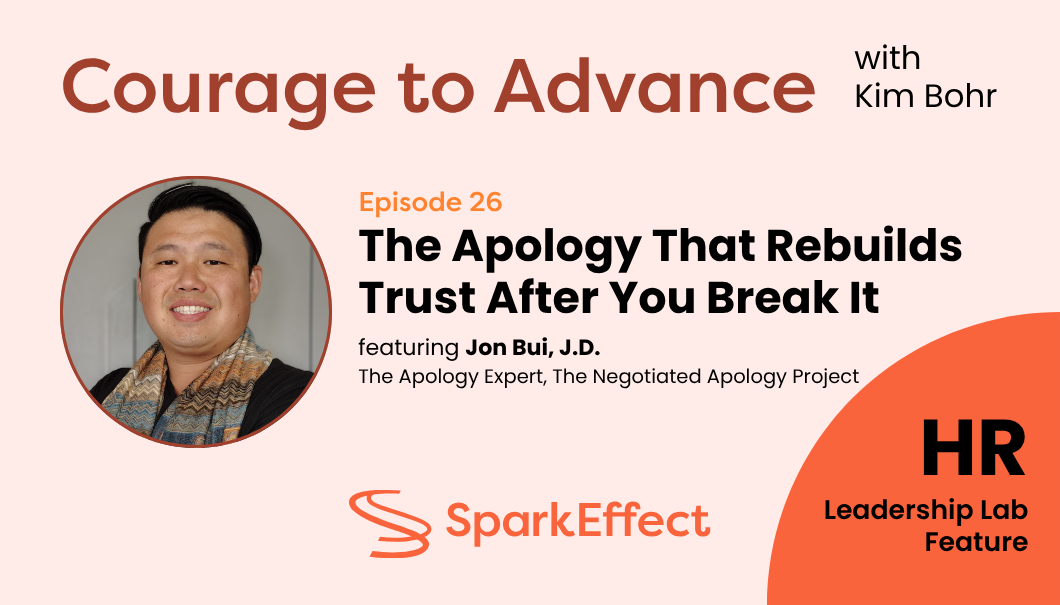





Episode 26: Featuring Jon Bui, J.D., Founder, The Negotiated Apology Project
Apology is one of the first skills we learn as children and one of the first leaders are taught to abandon. Somewhere on the way to the corner office, saying sorry gets reframed as a liability: a signal of weakness, or an invitation to legal exposure. So leaders avoid the exact conversations that would repair a fracture in trust, and the fracture widens.
On this episode of Courage to Advance, host Kim Bohr, CEO of SparkEffect, sits down with Jon Bui, J.D., to challenge that assumption. Jon spent years inside what he calls the law industry, where conflict gets resolved with the force of law and a monetary outcome. He saw a different set of problems, the kind where the real fix is relational rather than financial, and where the right moment to act comes long before anyone hires an attorney.
Jon is an attorney and mediator and the founder of The Negotiated Apology Project. He teaches apology not as sentiment but as a structured, learnable skill: acknowledge what happened and your role in it, then make restitution that either restores the person harmed or fixes the trait that caused the harm in the first place. It is a framework built from the courtroom and rebuilt for the workplace.
In this conversation, Jon walks through how leaders actually rebuild trust after they break it, why most people never start the conversation (it comes down to confidence, not technique), and what avoidance really costs in turnover, lost productivity, and legal exposure. In a moment where outrage travels faster than understanding, the ability to repair well has become a core leadership skill.
Watch
Listen
What You’ll Discover
- Why leaders are coached to treat apology as a legal risk, and what that view misses
- The two kinds of restitution that actually repair harm, and the one that only performs
- Why trust can be rebuilt but never returns to its original shape
- What low trust really costs, from turnover to a $250,000 lawsuit
- The three reasons people never start an apology, and why confidence is the fiX
Episode Highlights
[0:00]The apology skill leaders are taught to abandon Kim opens with Jon’s central claim: once trust is broken it can be rebuilt, but never into the same shape it was before.
[01:47] Why a lawyer left the law industry Jon names the gap he saw. Legal tools chase a monetary outcome when many workplace harms need a relationship outcome resolved earlier.
[08:58] Rebuilt, but never the same shape Using a relationship analogy, Jon explains why repaired trust takes a new form rather than snapping back to what it was.
[12:40] How to actually make it right Acknowledge the harm first, then choose restitution: rehabilitation that restores the person, or preventative work that fixes the underlying trait.
[17:19] What low trust costs One in five workers leave over toxic culture, replacing them runs about 1.5 times salary, and ignored issues can end in a $250,000 lawsuit.
[21:49] Apology as a proactive leadership skill Jon reframes repair as a skill best built when the stakes are low, and names confidence, not technique, as the thing that stops people.
[26:58] Where a leader starts Create a non-judgmental space so problems surface early, and get ahead of the hard facts before someone else uses them against you.
Key Takeaways for HR Leaders
1. Apology is a leadership skill, not a personality trait. Jon teaches it as a structured, trainable function. The barrier for most people is not knowing the steps; it is confidence. That means organizations can build the capability deliberately, the same way they build any other skill.
2. Repaired trust takes a new shape, so set expectations accordingly. You are not restoring the old relationship. You are building a different one that accounts for what happened. Leaders who understand this stop chasing a return to normal and start building something that actually holds.
3. Acknowledgement comes before restitution, and performative gestures do not count. Name the harm and your role in it first, then choose rehabilitation or preventative restitution. The dramatic, self-punishing apology fixes nothing because it never addresses what caused the harm.
4. Avoidance is the expensive choice. By Jon’s numbers, one in five workers leave over toxic culture, replacing each one costs about 1.5 times salary, and a pattern of ignored issues can become a $250,000 lawsuit. SparkEffect’s Trust Study points the same direction: retention rises from 52% at low trust to 93% at high trust.
5. Build the skill when the stakes are lowest. Repair works best as a proactive habit, not a crisis response. Create space for hard conversations early, when the issue is small. In the Trust Study, 71% of people had already lived through at least one significant disruption at work, so the question is not whether fracture will happen, but whether your people can repair it.
About Our Guest
Jon Bui is an attorney and mediator and the founder of The Negotiated Apology Project. He spent time as a legal recruiter before moving into conflict resolution full time.
Jon teaches conflict resolution using apologies and high-level negotiation strategies regularly employed by lawyers. As a graduate of Lewis & Clark School of Law, he is transforming the conflict resolution industry by empowering people with strategy and empathy to transform mistakes into relationship building opportunities. His training is essential for organizations seeking to build a powerful and everlasting positive culture, and for leaders who wish to lead with trust, accountability, and humanity.
Connect with Jon Bui
- Website: https://thenegotiatedapology.com
- LinkedIn: https://www.linkedin.com/in/jon-bui/ (where Jon is most active)
- Instagram: https://www.instagram.com/thenegotiatedapologyproject/
- Facebook: https://www.facebook.com/people/The-Negotiated-Apology-Project/61557791894716/
Notable Quotes
Jon Bui: “It’s better to permeate your organization with people who are comfortable having these tough conversations when the stakes are at their lowest.”
Jon Bui: “The very minimum that most people want is just kind of be seen and acknowledged.”
Kim Bohr: “Most leaders are coached to treat apology as a legal risk.”
Kim Bohr: “We published a report on the state of organizational trust that proved trust can be measured like any other KPI.”
Related Resources
- SparkEffect Trust Study— https://info.sparkeffect.com/trust-study-2025-download
- Trust in Turbulence: A Leader’s Field Guide — https://info.sparkeffect.com/leaders-field-guide
- SparkEffect Executive Coaching — https://sparkeffect.com/what-we-do/executive-coaching/
- SparkEffect Leadership Development Programs — https://sparkeffect.com/what-we-do/leadership-development-programs/
- Science of Trust eBook: https://sparkeffect.com/the-science-of-trust-ebook/
- About the Host: Kim Bohr – https://www.linkedin.com/in/kimbohr/
About Courage to Advance
Courage to Advance explores how visionary leaders are building the organizations they wish existed, companies that prove business doesn’t have to be dehumanizing. Hosted by Kim Bohr, President and COO of SparkEffect, each episode features executives who refuse to accept that traditional corporate practices are inevitable, sharing the experiments, resistance, and breakthrough results of choosing human flourishing alongside business success.
Subscribe anywhere you listen to podcasts. You can find links to all platforms HERE!
Visit: https://sparkeffect.com/sparkeffect-podcast-courage-to-advance/ for free resources and tools.
Receive New Podcast Episodes in Your Inbox