
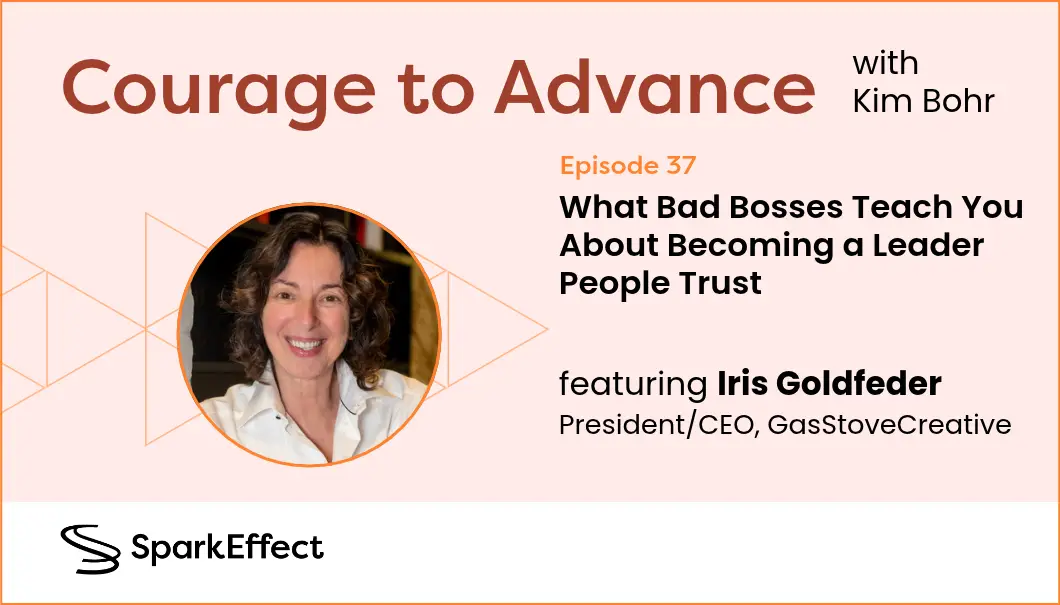





Episode 37: Featuring Iris Goldfeder, Founder and CEO, GasStoveCreative
The most honest feedback a company ever gets usually arrives too late. Kim Bohr opens this episode with a story about an exit interview that ran three and a half hours, all of it about one manager, every word of it available a year earlier for free while the employee still wanted to stay. Nobody asked. That is the gap this conversation lives in, the distance between the leader people quietly endure and the leader they would actually tell the truth to.
Kim Bohr, President and CEO of SparkEffect, sits down with Iris Goldfeder, a marketing agency founder who spent years working for bad bosses before she built a company of her own. They do not name names, but they agree on something uncomfortable. Most of what they know about leading well, they learned from being led badly. The praise email and the tear-down email that landed three hours apart on the same Saturday. The good idea dismissed because of who it came from. The HR office that promised a safe place and delivered a performance plan instead.
Iris Goldfeder is the founder and CEO of GasStoveCreative and the host of The Cookbook podcast. Her answer to every bad boss she ever had was to build the opposite. She works almost entirely with contractors, she protects their time and their expertise, and she leads with the respect she was denied. What makes her story land is that she is not theorizing. She lived the pattern and chose to break it.
This episode is about what it actually takes to be the place where bad leadership stops. Iris and Kim trade the stories that shaped them, name what really breaks trust at work (and why it almost always comes down to fairness), and make the case that nobody has to wait for a good boss to start becoming one.
Listen
🎧 Listen to Iris Goldfeder’s Full Conversation
Want the full episode? Listen to Iris Goldfeder on Courage to Advance, where she and host Kim Bohr get into the bad bosses who shaped them, what actually breaks trust at work, and how to become the leader people trust. [Listen Here!]
What You’ll Discover
- Why the best leadership lessons often come from the worst bosses
- How to break the cycle instead of passing bad treatment down to your own team
- What actually breaks trust at work, and why it usually comes down to fairness
- Why respect and appreciation change how people show up
- How to spot the boundary red flags before a working relationship goes sideways
Episode Highlights
0:00] The exit interview that came a year too late. Kim opens with a three and a half hour exit interview where every word could have been heard a year earlier, for free, while the employee still wanted to stay.
[2:35] The worst boss and the Saturday emails. Iris describes the boss who praised her work and tore it down three hours later on the same Saturday, and the ideas that got dismissed simply because they came from her.
[5:35] Turning down the return offer and leading on respect. A year after leaving, Iris gets the call to come back, and explains why she said no and how she now protects her team’s time and expertise.
[9:33] Where trust actually breaks at work. The sales commission answered with it’s called your salary, the public call-outs on the floor, and the manager who asked why she was reading a personal email the day she learned her friend was dying.
[12:50] The anonymous 360 that was not anonymous. Kim shares her own trust break, giving honest feedback she was promised would stay confidential and getting hauled into the office the next day for it.
[14:14] The principles they lead with now. Empathy and compassion, growing people, integrity, and the clarity Kim adds, naming why leaders avoid hard conversations and call it kindness.
[22:38] Boundaries, red flags, and what courage to advance means. Iris on the clients she set no boundaries with, the after-hours expectations she should have caught, and why the right people fill the space when the wrong ones fall away.
Key Takeaways for HR and People Leaders
- Bad bosses are often the most effective leadership teachers. The treatment that hurt you is also a precise map of what not to do. Iris turned every bad boss into a rule for her own company, which is the difference between repeating a pattern and breaking it.
- Trust breaks on fairness long before it breaks on performance. Being underpaid for the revenue you drive, being punished for using HR, being burned after honest feedback. Each one teaches people the system is not on their side, and that lesson outlasts the job.
- The feedback you need most is free, if you ask while people still care. A three and a half hour exit interview is a year of unspoken truth arriving too late. Ask your people how things are really going now, and make it safe to answer honestly.
- Appreciation and respect are performance tools, not soft extras. People do better work when their time and expertise are respected and their contributions are named. The reverse, being dismissed or taken for granted, is what sends good people looking.
- Boundaries are a leadership skill, and the red flags show up early. The clients and relationships that go wrong are usually the ones where no boundary was ever set. Watch what people expect of your time after hours, on weekends, and late at night.
About Our Guest
Iris Goldfeder is the Founder and CEO of GasStoveCreative, a full-service marketing agency helping businesses cut through the noise and build marketing strategies that actually work for them. With more than 30 years of marketing experience, and a decade spent as a chef, Iris knows that the best results come from the right recipe, a little creativity, and an approach tailored to the person or business in front of you.
Iris is also the host of The Cookbook: Recipes for Business & Marketing Success podcast and former host of Unique Voices on Futures Television. She has appeared on dozens of podcasts discussing marketing and website accessibility and has spoken for organizations and events including the National Institute for Social Media, Women in Steel, and VC Europe X.
At the heart of Iris’s work is a simple philosophy: meet businesses where they are, simplify what feels overwhelming, and help them focus on the marketing that will actually move them forward. Her trademarked mantra says it best: “If you’re not online, you’re not an option.®”
Connect with Iris Goldfeder
- Website: https://gasstovecreative.com/
- LinkedIn: https://www.linkedin.com/in/igoldfeder/
- The Cookbook podcast: https://gasstovecreative.com/the-cookbook-podcast/
- Facebook: https://www.facebook.com/gasstovecreative
- Instagram: https://www.instagram.com/gasstovecreative/
Notable Quotes
Iris Goldfeder “I always want to treat them with respect. Respect for their time. Respect for their expertise.”
Iris Goldfeder “It didn’t matter how she treated me. What mattered was, can I sleep at night?”
Kim Bohr “People leave because of leadership.”
Kim Bohr “So many of these conversations, people make up the excuses as to why they won’t have them.”
Related Resources
SparkEffect Trust Study 2026 — https://info.sparkeffect.com/trust
- Watch more on managers support during disruption as a norm –https://youtu.be/tbC0TUD6ynM
SparkEffect Executive Coaching — https://sparkeffect.com/what-we-do/executive-coaching/
SparkEffect Leadership Development Programs — https://sparkeffect.com/what-we-do/leadership-development-programs/
Science of Trust eBook: https://sparkeffect.com/the-science-of-trust-ebook/
SparkEffect CEO and Board Advisory: https://sparkeffect.com/what-we-do/ceo-board-advisory/
- Connect with the Host: Kim Bohr – https://www.linkedin.com/in/kimbohr/
About Courage to Advance
Courage to Advance explores how visionary leaders are building the organizations they wish existed, companies that prove business doesn’t have to be dehumanizing. Hosted by Kim Bohr, President and COO of SparkEffect, each episode features executives who refuse to accept that traditional corporate practices are inevitable, sharing the experiments, resistance, and breakthrough results of choosing human flourishing alongside business success.
Subscribe anywhere you listen to podcasts. You can find links to all platforms HERE!
Visit: https://sparkeffect.com/sparkeffect-podcast-courage-to-advance/ for free resources and tools.
Receive New Podcast Episodes in Your Inbox