
SEATTLE, WA (Sept. 15, 2026) – SparkEffect, the human-first partner for Coaching, Leadership Development and Career Transition, has again partnered with Aaron Delgaty, PhD, of Note & Niche, for their second Trust Research Report. An annual survey study of employees, managers, and executives on how organizations handle disruption and what it does to trust.
2025’s “Trust in Turbulence: The 2025 State of Organizational Trust. How Leaders Can Turn Disruption into Competitive Advantage” found that when organizations treat trust as a business strategy during disruption, they don’t just protect morale; they outperform peers who faced no disruption at all.
Where year one of the study established that trust and business performance move together, year two, “Trust in Turbulence: The 2026 State of Organizational Trust. How Organizations Absorb Disruption Without Losing Trust” explains the mechanism.
Key findings include:
- AI lands on the manager first: Managers felt the impact of AI twice as much as their employees.
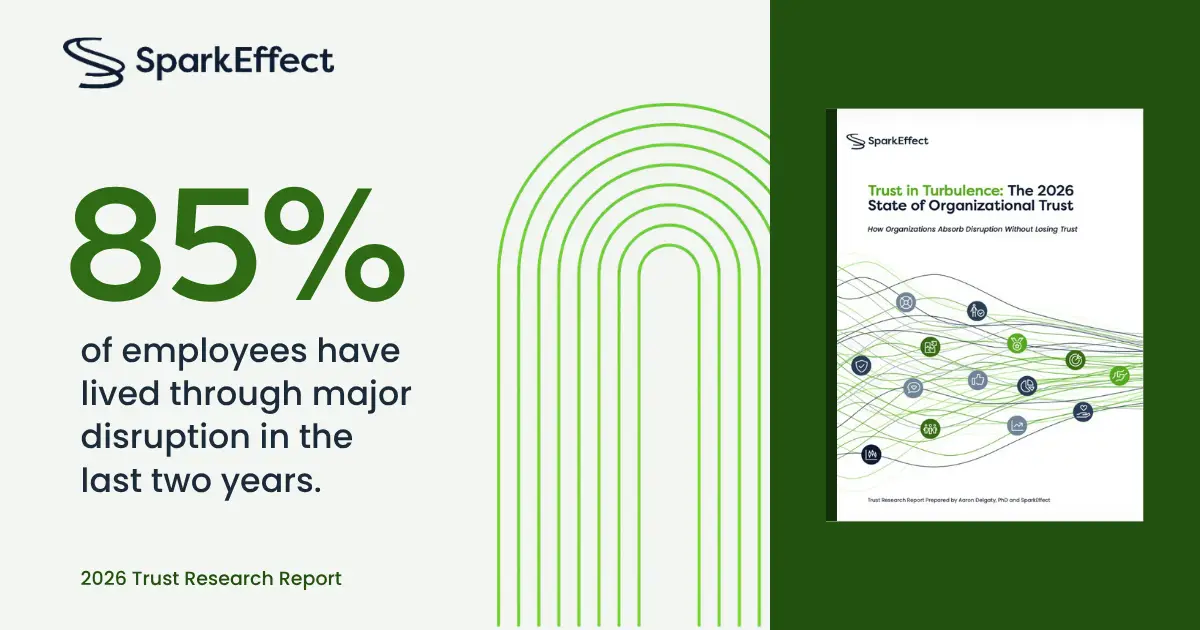
- Disruption is the operating condition: 85% of respondents experienced at least one significant disruption in the previous 24 months. Nearly half (48%) involved AI, either its introduction or the ongoing demands of using it.
- Trust routes through the manager: Direct-manager support is the most common intervention, the best-rated, and the most fragile.
- Quality is what separates outcomes: Quality is not about raising the ceiling. It is about removing the floor. As intervention quality rises, the range of outcomes narrows and severe negative outcomes become rare, then the returns flatten. That points to a different goal than optimization.
- Trust shows up in performance: Respondents in high-trust organizations report materially stronger outcomes than those in low-trust organizations, with 35% higher revenue scores, 47% higher retention scores, 46% higher customer reputation scores, and 46% higher industry reputation scores.
“Often, the first solution is to give managers more training when what they really need is clear guidance they can share, something concrete to offer instead of just reassurance, and a clear point for handing off problems they can’t solve,” said Kim Bohr, President and CEO of SparkEffect. “The goal isn’t for managers to handle every intervention themselves, but to help them become part of an effective system.”