
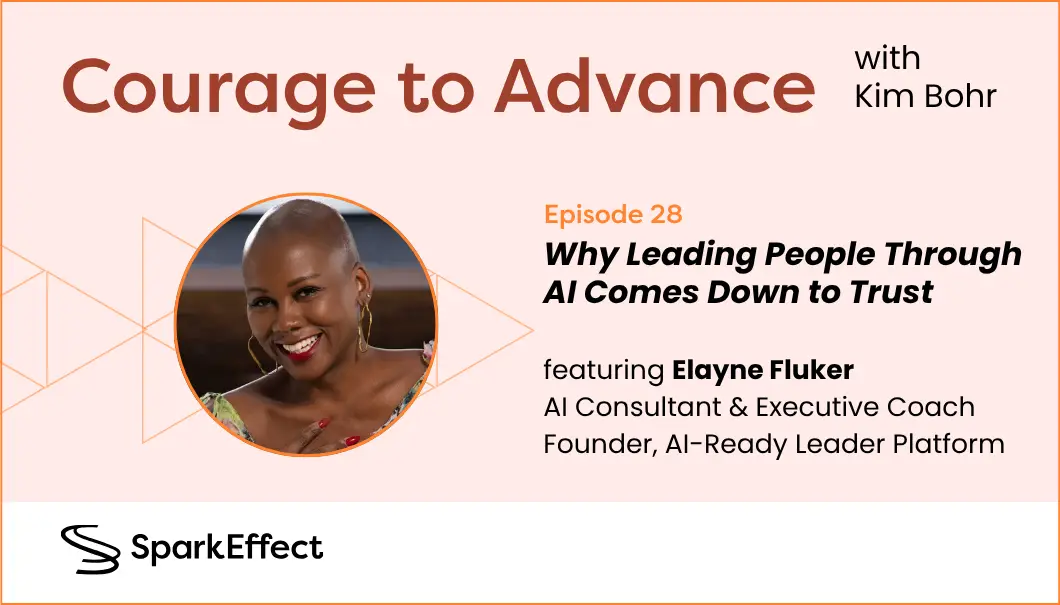





Episode 28: Featuring Elayne Fluker | Certified AI Consultant, Executive Coach, and Founder of the AI-Ready Leader Platform
Most organizations have already spent the money on AI training. Far fewer can point to real adoption. A DataCamp study found that 82% of organizations train their employees on AI, while 59% still report a skills gap. The sessions happened. The behavior did not follow.
On this episode of Courage to Advance, host Kim Bohr and Elayne Fluker locate the reason in a place most rollouts ignore: trust. People will not lean into a tool that feels like a threat to their standing, and mandating adoption only sharpens the quiet fear that they are training their own replacement. What actually closes the gap is whether people trust that their experience still matters.
Watch
Listen
Elayne is a Certified AI Consultant, an ICF-trained executive coach, and the founder of the AI-Ready Leader Platform. She spent 25 years as a media executive at Essence, Martha Stewart Living, and Conde Nast, riding out every wave of disruption in an industry that got hit first. Her answer to the adoption gap is a framework she calls Human Nurture: the deliberate work of developing your people so they can rise to the AI moment instead of being broken by it.
Across the conversation, Elayne and Kim get specific about what that takes: the four tenets of Human Nurture, the fear that actually blocks adoption, and why honoring people’s experience is the trust move that makes an AI transition hold together.
What You’ll Discover
- Why AI adoption stalls even after the training is done, and why trust is the variable most rollouts miss
- How mandating AI capability deepens the exact fear that keeps people from using the tools
- The four tenets of Human Nurture: safety over fear, development over extraction, honoring experience, and leaders who go first
- What it means to honor experience so people trust their expertise will still be valued
- The Five R’s of the Empowered Ask: Ready, Reasons, Receipts, Request, Reciprocity
- How to test a big change before you commit to it
Episode Highlights
[1:18] Reinventing five or six times on purpose. Elayne describes walking away from roles that still worked, and why she credits curiosity rather than a master plan for a career she remade across magazines, digital, video, and podcasting.
[4:21] You take your experience with you. Elayne’s reframe for anyone afraid a pivot wastes their past: none of the work is left behind, it comes with you, and that is what frees a leader to change.
[5:10] You don’t have to be fearless. Why the pressure to know everything before you start is what actually stops leaders, and how “let me explore this” beats waiting to feel ready.
[7:13] The Mexico test: do laundry, buy groceries. How Elayne pressure-tests a big move by living the ordinary version first, staying a month before deciding, because a place stops being a vacation once you have chores.
[10:38] Get Over “I Got It” and the ask reflex. Kim asks about the book, and Elayne unpacks “I got it” syndrome, the automatic refusal of help, and why it quietly costs people trust, health, and support.
[16:11] The Five R’s of the Empowered Ask. Elayne’s checklist for people who don’t know how to ask for help: Ready, Reasons, Receipts, Request, and Reciprocity.
[20:41] The real fear isn’t the tools. Why “I’ve been here 15 years and I’ll be left behind” drives more resistance than the technology, and how mandating AI capability deepens exactly that fear.
[23:19] AI failures are leadership failures. Kim presses on the claim, and Elayne explains why stalled AI traces back to leadership, not the tools, and what leaders are avoiding.
[24:57] The four tenets of Human Nurture. Safety over fear, development over extraction, honoring experience so people trust their expertise still matters, and leaders who go first.
[29:36] What courage to advance means to Elayne. Her answer: courage is the willingness to say “I don’t know, let me see,” and to only recognize later that the leap was brave.
Key Takeaways for HR Leaders
- AI adoption comes down to trust, not tooling. People adopt what they trust and resist what threatens them. SparkEffect’s own research shows trust rises 12% when disruption is handled well and falls 28% when it is handled poorly, and an AI rollout is a disruption. Treat adoption as a trust problem and the tool usage follows.
- Mandates manufacture the fear that blocks adoption. When the message is “learn this or else,” people hear a threat to their standing, not an invitation. Elayne’s phrase is that organizations are trying to mandate their way to AI capability, and it backfires. Encouragement and a clear how beat a deadline and a threat.
- Honor experience or lose it. The worry underneath AI resistance is “am I training my replacement.” People need to trust their expertise still matters on the other side of the change. Name it out loud, because trust in direct leaders is the highest but most fragile trust in an organization and it drops fastest during disruption.
- Go first, out loud, including what did not work. The most practical move Elayne offers is a leader modeling “here is what I tried, what do you know about this.” Vulnerability, not expertise, is what gives people permission to learn in the open, and it is how a leader protects the trust their team places in them.
- Give people the script, not a pep talk. “Just be open” is not an instruction. Both the Five R’s and the AI-Ready Leader diagnostic exist because people asked to change want an implementation plan. Structure is the kindness, especially when the thing you are asking for is uncomfortable.
- Reinvention is a practice, not a leap. You take your experience with you, you do not have to be fearless, and you can test a change before committing, the way Elayne stayed a month in a new place before moving. Curiosity is a move a leader can make on purpose, and it is the one this moment rewards.
About Our Guest
Elayne Fluker is a Certified AI Consultant, an ICF-trained executive coach, and founder of the AI-Ready Leader Platform™.
She spent 25 years as a media executive at Essence, Martha Stewart Living, and Conde Nast, riding out every wave of disruption in the industry that got hit first. Now she coaches senior leaders through the one they’re in.
Her work sits at an intersection most consultants don’t occupy: decades of editorial judgment, an active executive coaching practice, hands-on AI fluency, and the lived experience of founding a media company and a streaming platform.
She is the author of Get Over “I Got It” (HarperCollins Leadership), a LinkedIn Top Voice with more than 100,000 learners through LinkedIn Learning, and host of The AI-Ready Leader podcast.
Her thesis: AI training teaches tools, but the AI era will be won on Human Nurture, the deliberate work of developing your people so they can rise to this moment instead of being broken by it. Human nature is what your people are. Human Nurture is what your leadership does with it.
Connect with Elayne Fluker
Website and free AI-Ready Leader diagnostic: https://elaynefluker.ai/ai-ready-leader
Book: Get Over “I Got It” (HarperCollins Leadership), on Amazon: Here!
Notable Quotes
Elayne Fluker: “Companies are investing all this money in training, but their people aren’t using the tools or using it at the level that they want.”
Elayne Fluker: “I think organizations are trying to mandate their way to AI capability.”
Elayne Fluker: “For me that’s the courage to advance: being open and being able to say, I don’t know, let me see, let me figure this out.”
Kim Bohr: “What if the AI era won’t be won by the leaders with the best tools, but by the ones who protect what those tools can’t replace?”
Kim Bohr: “I love the idea of human nurture, and I think that feels so needed right now, given how cold this AI transformation can feel in some organizations.”
Related Resources
- FREE DOWNLOAD – State of Organizational Trust : https://sparkeffect.com/blog/how-to-build-trust-in-the-workplace-what-actually-works/
SparkEffect Trust Study 2025 — https://info.sparkeffect.com/trust-study-2025-download
Trust in Turbulence: A Leader’s Field Guide — https://info.sparkeffect.com/leaders-field-guide
SparkEffect Executive Coaching — https://sparkeffect.com/what-we-do/executive-coaching/
SparkEffect Leadership Development Programs — https://sparkeffect.com/what-we-do/leadership-development-programs/
Science of Trust eBook: https://sparkeffect.com/the-science-of-trust-ebook/
SparkEffect CEO and Board Advisory: https://sparkeffect.com/what-we-do/ceo-board-advisory/
- Connect with the Host: Kim Bohr – https://www.linkedin.com/in/kimbohr/
About Courage to Advance
Courage to Advance explores how visionary leaders are building the organizations they wish existed, companies that prove business doesn’t have to be dehumanizing. Hosted by Kim Bohr, President and COO of SparkEffect, each episode features executives who refuse to accept that traditional corporate practices are inevitable, sharing the experiments, resistance, and breakthrough results of choosing human flourishing alongside business success.
Subscribe anywhere you listen to podcasts. You can find links to all platforms HERE!
Visit: https://sparkeffect.com/sparkeffect-podcast-courage-to-advance/ for free resources and tools.
Receive New Podcast Episodes in Your Inbox