
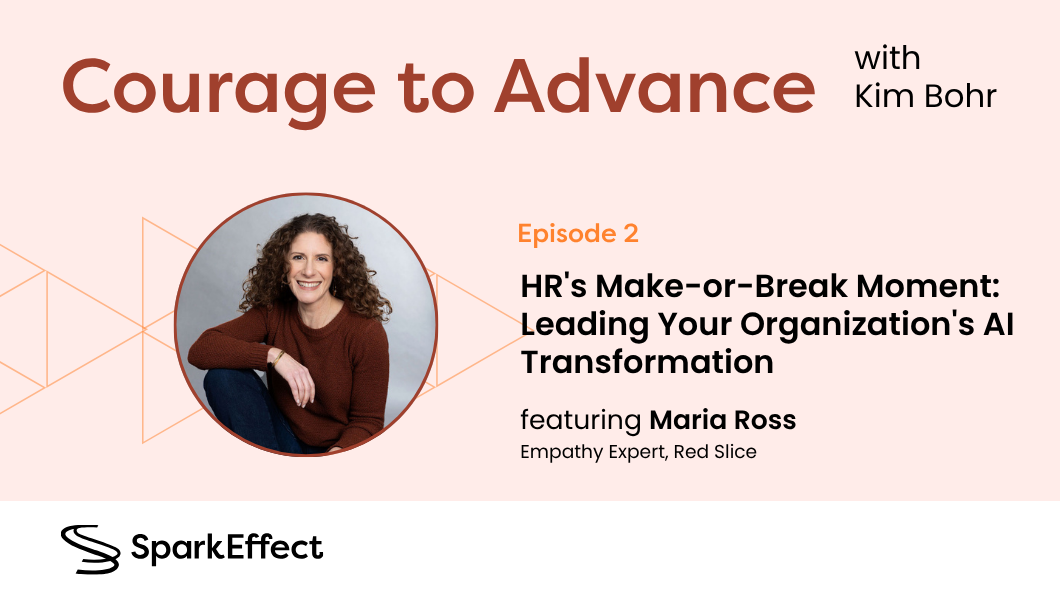





Season 2 Episode 2: Interview with Maria Ross
71% of employees just experienced major disruption in the last 24 months—most of it AI-driven. And HR leaders have about six months to decide: Are you going to architect this transformation, or watch someone else make people decisions without you?
In this powerful episode, Kim Bohr sits down with empathy expert and change management veteran Maria Ross to make an urgent case: HR must lead AI transformation, not just respond to it. Drawing on SparkEffect’s Trust Study and Maria’s deep expertise, they reveal why organizations that get this right will build a trust dividend—while those that don’t may never close the trust gap.
Listen
What You Will Discover
The Trust Crisis Hiding in Plain Sight
- Why only 36% of organizations emerged from disruption with stronger trust
- How direct manager trust takes the biggest negative hit during crisis—despite being the strongest trust element
- Organizations with strong post-crisis care are 6.5× more likely to have a clear strategy for navigating future disruptions
The Business Case for HR Leadership
- Why treating AI as “just a tech implementation” is organizational malpractice
- The five “EPIC” human skills AI can’t replicate: Empathy, Presence, Opinion/Judgment, Creativity, and Hope/Vision/Leadership
- How empathetic leadership creates dramatic outcome differences: 76% vs 32% engagement, 61% vs 13% innovation capability, 50% vs 17% workplace inclusion
Your Playbook for Claiming Strategic Influence
- Three conversation openers to get your voice in the room: risk mitigation, business value, and strategic leadership framing
- Why “how well my team handled the change” is the strongest positive trust intervention
- The surprising finding: transparency about uncertainty is the least likely intervention to improve trust and most likely to decrease it
Episode Highlights
[00:00] The Six-Month Ultimatum – HR’s narrow window to position itself as the architect of AI transformation
[03:57] The Disruption Data – Breaking down the Trust Study: 71% experienced disruption, AI-driven changes most common, but leadership turnover had highest work impact
[09:39] Why HR is the Missing Voice – Four barriers keeping HR out of AI strategy: treated as tech initiative, siloed decision-making, perceived lack of AI fluency, organizational fears
[15:03] The EPIC Skills Framework – Unpacking which human capabilities complement AI success
[22:52] Trust by the Numbers – The Catalyst study data showing empathetic leadership’s impact on innovation, engagement, and inclusion
[31:00] Opening the Conversation – Three strategic approaches for getting HR heard in AI planning
[39:57] The Communication Paradox – Why transparency about uncertainty often backfires
[43:04] Post-Episode Q&A – Kim answers audience questions on building AI readiness and supporting managers
Powerful Quotes from this Episode
“We wouldn’t perform surgery with only the surgeon in the room. We need the anesthesiologist, we need the nurses, we need all the specialists. Yet most companies are performing this AI transformation surgery with only the tech team scrubbed in.” — Kim Bohr
“You can’t have trust with someone you’re already skeptical about. And now that person is saying, ‘We’re going to introduce AI into our team this year.’ How are you going to trust them to be looking out for you? How are you going to trust them to upskill you?” — Maria Ross
“The organizations that get this right in the next six months will build a trust dividend. The ones that don’t will be managing a trust gap they may never close.” — Kim Bohr
“Communication doesn’t start when you flip the switch. People need to be communicated with about what’s coming, and most importantly, here’s why.” — Maria Ross
“Trust is not a soft skill. It absolutely has a direct correlation to revenue, reputation and retention.” — Kim Bohr
Featured Resources
Trust in Turbulence™: The 2025 State of Organizational Trust
This research report reveals how trust has become a measurable business asset—showing how leaders can turn disruption into a competitive advantage by strengthening retention, reputation, and revenue. Download here!

Trust in Turbulence™: A Leader’s Field Guide to Trust
A practical handbook that equips leaders with everyday tools, frameworks, and rituals to consistently build clarity, fairness, and care—turning trust from an abstract value into daily practice. Download here!

Unlock Your Trust Dividend: Free Strategic Consultation
Discover how to transform organizational disruption into a competitive advantage by scheduling a complimentary 45-minute trust strategy session with our leadership advisory team. Schedule today!
Connect & Continue the Conversation
Kim Bohr LinkedIn: Connect with Kim | Website: SparkEffect.com | Podcast: Courage to Advance
Maria Ross Podcast: The Empathy Edge | Book: The Empathy Dilemma
Share your AI transformation insights at couragetoadvancepodcast.com.
Take Action: Three Steps for HR Leaders
- Assess Your Current Position Where is HR in your organization’s AI adoption? Has a strategic plan been rolled out? Is HR driving it, part of planning, or being told what’s decided? Use the frameworks from this episode to honestly evaluate your starting point.
- Prepare Your Business Case Choose one conversation approach from the episode:
- Risk Mitigation: “We’re missing critical factors in our assessment” / “Our change management track record shows we need people expertise upfront”
- Business Value: “AI implementation success depends on workforce adoption” / “We know the real business impact of broken trust on revenue, retention and reputation”
- Strategic Leadership: “This transformation requires organizational design expertise” / “We need a unified workforce strategy, not fragmented people decisions”
Back it with the Trust Study data: only 36% emerge stronger, manager trust is most fragile, organizations with strong crisis response are 6.5x more likely to have a clear strategy.
- Lead One Initiative This Quarter Don’t wait for permission. Identify one AI-related initiative—communication guidelines, fairness assessment process, or manager enablement tools. Start building your track record as an AI transformation architect.
About This Episode
This episode originated as a live webinar presentation that generated such powerful insights, Kim knew the podcast audience needed to hear it. The conversation has been edited for podcast format, with Kim adding context and answering audience questions in the closing segment.
About Courage to Advance: We explore how leaders are building the organizations they wish existed—featuring executives who refuse to accept that business has to be dehumanizing. We dig into the messy middle of transformation: the concrete practices, honest failures, and hard-won lessons of organizational courage.
Subscribe to Courage to Advance on your favorite podcast platform.
Trust isn’t soft. Empathy isn’t optional. And HR’s moment to lead is right now.
Receive New Podcast Episodes in Your Inbox